
Introducing Squid Intents to the World

TL;DR
Cross-chain should feel simple. But anyone who's actually used crypto across ecosystems knows the hard truth: fragmentation still exists at every layer. Liquidity is scattered, gas spikes occur mid-swap and quotes expire while you’re still reading them.
The infrastructure has come a long way since Squid first threw our hat in the ring back in 2022. Bridges, GMP, intent-based routing, each one a genuine step forward - but progress and solved are not the same thing. If blockchains are really going to become the rails the world actually runs on, “better than it used to be” won’t cut it. It has to be simple enough that complexity becomes invisible.
Squid Intents is our answer to that. Built on Coral, our original intent protocol, it takes a model we’ve already proven and evolves it for real scale. It’s the next iteration of infrastructure already tested across billions in volume, millions of transactions, and across the full breadth of crypto.
Squid Intents: A New Execution Engine for Intent-Based Swaps
Squid Intents is Squid's biggest upgrade to date. Under the hood, it's a settlement protocol that minimizes onchain logic and maximizes execution quality, turning user intent into onchain token transfers through post-deposit RFQ auctions and TEE-verified batched settlement. As a non-custodial intent protocol, it uses solver auctions and offchain coordination, reducing onchain complexity to mere token transfers, while preserving decentralized settlement guarantees.
tl;dr: it just works.
You tell Squid what you want, and it quietly handles the rest, without turning the blockchain itself into a traffic jam. By treating blockchains as settlement layers rather than execution layers, Squid avoids the congestion, slippage, and failed transactions that make cross-chain feel hard. The complexity doesn't disappear, it just stops being your problem.
Opening Squid up to New Use Cases
Squid Intents unlocks a wide range of real-world use cases across crypto, and developers can access it directly through the Squid API, SDK, or cross-chain widget. Users can try it today on Squid Bridge.
Built for the demands of real-world finance, Squid Intents handles spot trading, cross-chain payments, treasury management, app deposits and withdrawals, and portfolio rebalancing. Wallets and fintech apps can offer seamless swaps across ecosystems, asset issuers can provide liquidity once and reach users on multiple chains, and market makers can supply liquidity to cross-chain trades across the network.
Whether it's stablecoin payments between different chains, onboarding new networks, or accessing native assets on chains that operate entirely outside the EVM, Squid Intents provides the settlement layer that makes these interactions possible.
It All Began With Smart Contracts
Like most DeFi protocols, Squid’s original intent protocol Coral relied on smart contracts deployed across chains to coordinate cross-chain execution and settlement. It utilized GMP protocols like Axelar and LayerZero, and supported trades across any token on popular EVM chains like Ethereum, Arbitrum, Base, and beyond.
Coral safely moved billions, earning trust on both sides. It's what got us here. But crypto doesn't stand still, and neither does Squid.
How Squid Intents is Built Different
At the core of Squid Intents is a fundamental shift in how cross-chain logic is handled: away from smart contracts deployed across chains, and toward Trusted Execution Environments (TEEs). This delivers efficiency while maintaining the decentralized and non-custodial nature of the protocol, and ensures that Squid is not limited to EVM chains, but can expand to any chain and any token, including chains that don’t have smart contracts.
Squid’s TEEs are powered by Cubist, who we chose for their formidable security background, having secured over $10B USD already, and their commitment to crypto's original values: decentralization and privacy. Their approach ensures high availability, censorship resistance, and decentralized upgrade and deployment pathways for protocols developing on their platform.
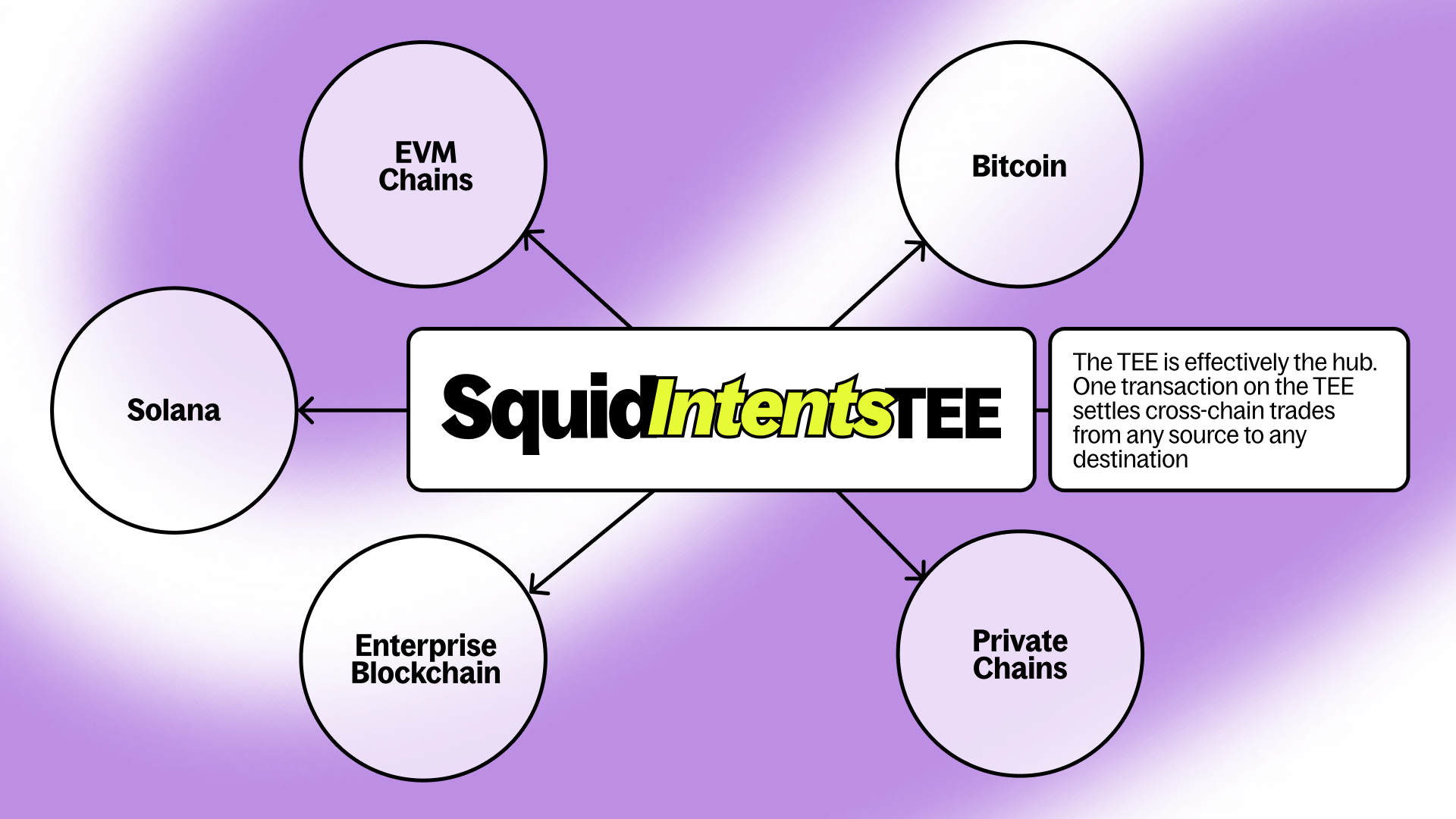
What Are Trusted Execution Environments (TEEs)?
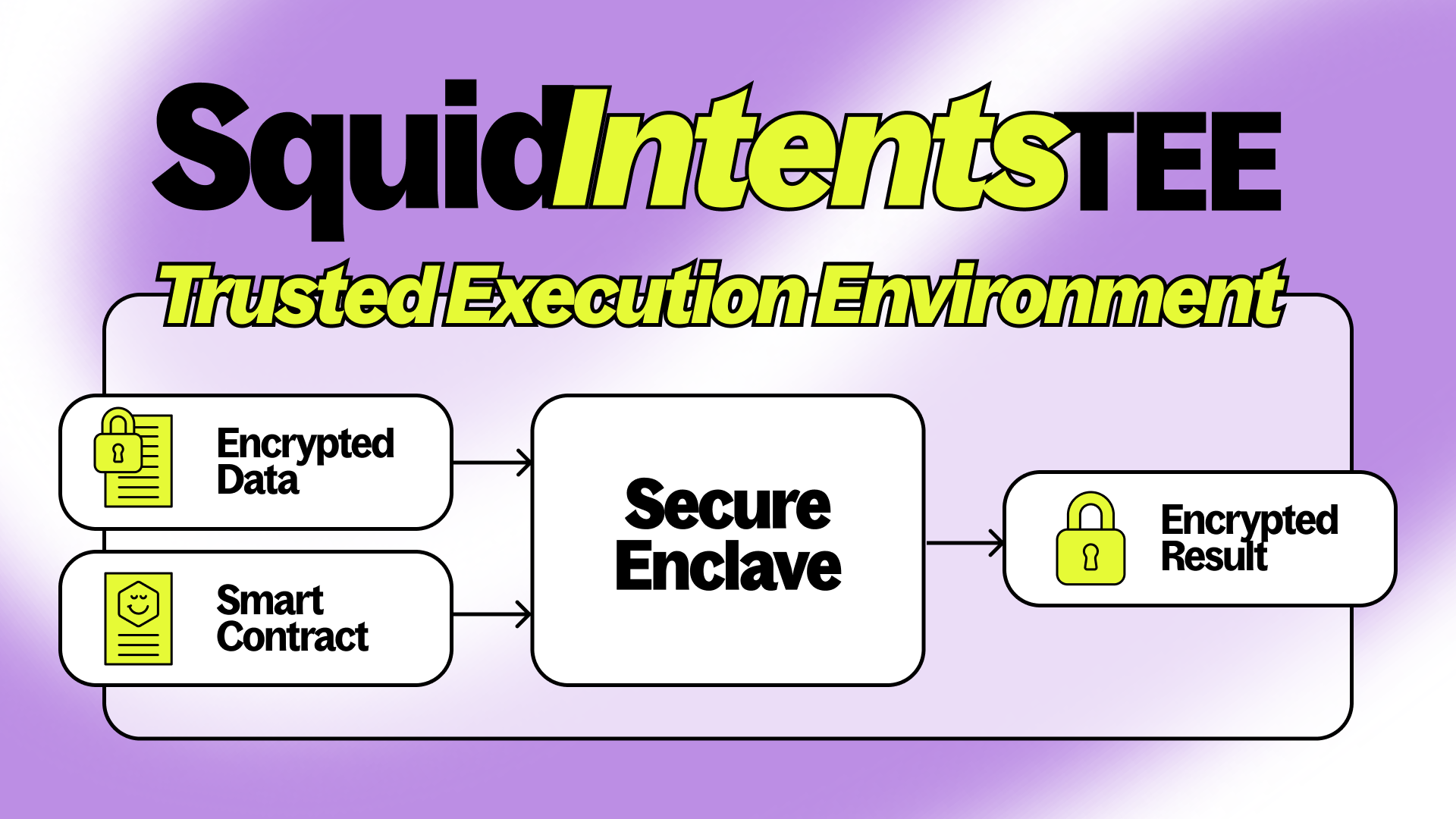
A TEE is a secure enclave inside a processor where code runs in complete isolation, enforced by the hardware itself rather than network consensus. The processor produces cryptographic proof that the code ran correctly, without requiring the entire network to re-execute it.
How is that different from a smart contract?
With a smart contract, every node in the network runs the same logic and must agree on the output for it to be valid - trust comes from thousands of nodes verifying the same computation publicly. With TEEs, trust comes from the hardware itself, which produces a cryptographic attestation proving the code ran correctly. Smart contracts are limited by what a public network can compute. TEEs remove that ceiling by running logic privately and offchain, then settling only the proof onchain.
Why Squid Intents matters
Here's the thing about most cross-chain systems: they work great, until they don't. Competing on surface-level claims - faster, cheaper, more coverage - is easy. But execution quality ultimately comes down to one thing: the condition of the underlying chains. Gas spikes, network congestion, unpredictable block times, these are the variables that break cross-chain trades when systems aren't built to handle them.
If your infrastructure only works when gas is stable, markets are calm, and users click within an expiry window, it's not built for scale. Squid Intents was designed to work when things aren't perfect, because they rarely are. That meant getting three things right: keeping costs down, driving failures toward zero, and keeping execution simple, regardless of what the underlying chains are doing.
Cross-chain shouldn't require perfect conditions. With Squid Intents, it doesn't.
What Squid Intents Means for End Users, Chains and Integrators
1) Near-minimum gas costs
By pulling as much application logic off the source and destination chains, the only logic executed on those chains is what must be true in any trade: a token transfer.
Everything else is handled offchain and settled efficiently through TEEs. One transaction on the TEE can settle an effectively unlimited number of source and destination chains, without additional onchain complexity. While transactions on Squid are already cheap, the cost per settled transaction trends toward zero as the network scales and market maker competition increases.
With Squid Intents, we looked at the latest in research from rollups, single chain spot exchange and bridges and combined them to bring Squid to the state of the art. This new technology will let Squid reach levels of reliability and scale high enough to work with traditional institutions, and remain at the leading-edge of cost and speed for years to come. - Fig, Squid Co-Founder
2) Tighter pricing, because the auction happens at the right time
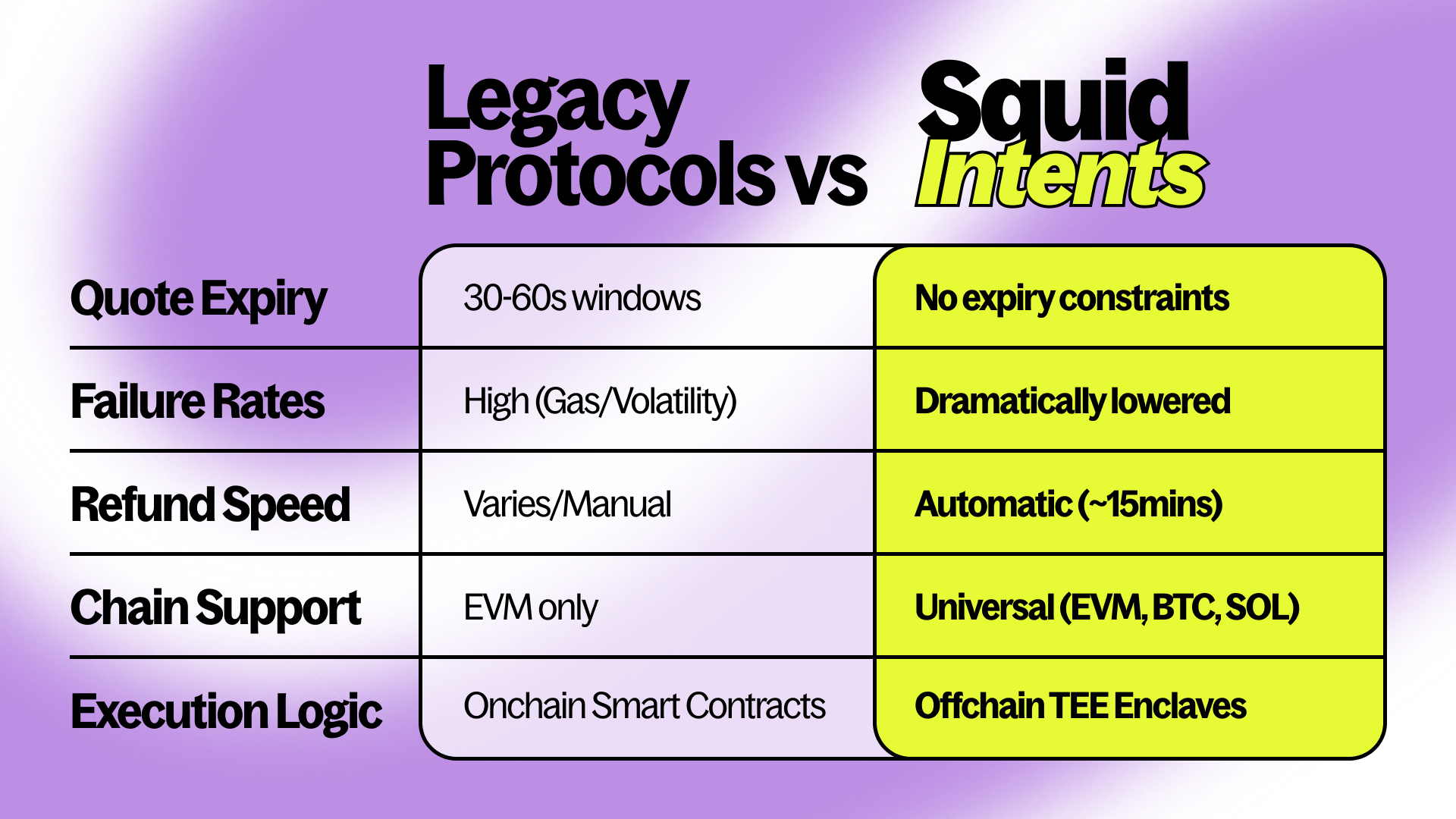
In other intent-based cross-chain systems, solvers quote with an expiry. You’re given 30–60 seconds to accept. That forces solvers to price in volatility and gas movement during that window, taking a wider spread to cover their risk.
Squid Intents removes that pattern entirely. Instead, with RFQ auctions after the user’s deposit, it becomes semi-finalized on the source chain before the auction even begins. The winning solver can hedge milliseconds after winning, which means tighter quotes. Users don't get a "guaranteed amount" upfront, they get the best market price at execution time.
3) Dramatically lower failure rates
Removing expiry eliminates the two most common sources of failure in onchain finance: users taking too long to accept a quote, and volatility or gas moving inside an expiry window.
High reliability is what separates experimental technology from real technology. Systems like Stripe maintain failure rates below 1 in 100,000. Squid Intents is built to that standard.
4) Refunds in ~15 minutes
If a Squid Intents transaction fails, funds are automatically refunded on the source chain within 15 minutes. In crypto, speed isn't always the most important factor, certainty is.
5) Better multisig compatibility
Expiry windows are hostile to multisigs. Coordinating signers takes time, and “accept within 30 seconds” is basically telling every DAO, treasury and institution to get lost. Squid Intents removes the expiry constraint entirely, making swaps far more compatible with multisig workflows.
6) Support for non-smart contract chains
Squid Intents is compatible with chains that do not have smart contracts, including XRPL and Bitcoin, with expanded support coming soon. It marks the early foundation for a world where digital value flow doesn’t only mean EVM-to-EVM, but between anywhere and everywhere it actually exists.
7) Faster expansion, more independence
Squid Intents enables Squid to expand to chains more independently, without relying on third-party interoperability layers in the same way. Axelar will still be used as a verifier, alongside multiple RPC connections, but the net effect is faster expansion, broader chain types, fewer constraints.
The Future
At Squid, we’re working toward a future where the entire stack, from protocol infrastructure to developer tools and user interfaces, works together to make cross-chain interactions simple and intuitive. Users should be able to trade tokens, move assets, and act on any opportunity, without the friction that's become accepted as normal.
Squid Intents is the latest step toward that future. It brings the cheapest possible protocol layer for intents, dramatically lower failure rates, tighter pricing, and faster expansion to more chains - with execution quality strong enough that even centralised providers struggle to compete on cost. Squid becomes something ready for institutional use, real-world use, and every use case that hasn't been possible yet.
The rails are being built, and Squid Intents is what they look like at scale. Try the full Squid Intents experience at app.squidrouter.com.
Further Reading
Important Notice for Integrators
If you already integrate Squid via API/SDK, the high-level integration remains familiar: Squid Intents uses the same /v2/route endpoint as all Squid transactions.
A few important practical changes:
Squid Intents is not enabled by default.
Integrators can contact the Squid team to get it enabled on their integrator ID.