
State of Squid
State of Squid
Squid makes crypto whole. One platform, one transaction, any token, any chain.
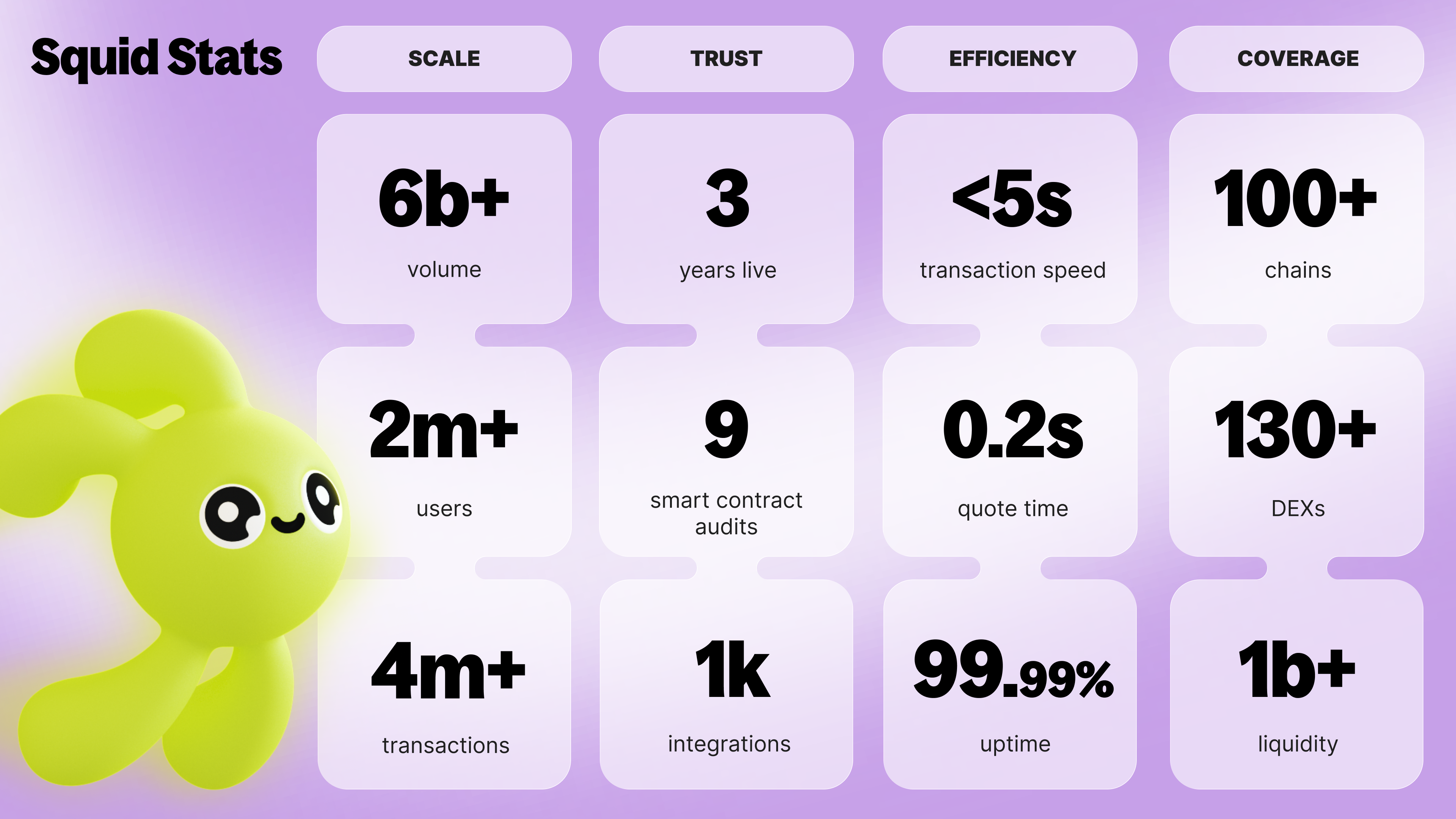
Since launching in January 2023, we have routed over $6 billion in volume across more than 100 blockchain networks for over a million users, through our frontend app and more than a thousand partner integrations. We build and maintain the entire stack as a single system, spanning settlement protocol, routing engine, developer tools, and consumer products.
With the greatest culmination of Squid just around the corner, we take a comprehensive look at where we stand today: what we've built, how it works, who uses it, and where we're going next.
If you believe in crypto, then you believe in Squid.
Every crypto cycle produces new assets on new chains, and users need to reach them. DeFi summer sent people across Ethereum and its L2s chasing yield. NFTs sent them between marketplaces. Memecoins sent them to Solana, Base, and dozens of other chains. RWAs are drawing investors toward tokenized assets scattered across ecosystems. AI agents are initiating transactions that span multiple chains without human involvement. The narrative changes with every cycle. The need for cross-chain movement does not and neither does the desire for easier access to assets.
The founding conviction behind Squid came from seeing these cycles accelerating and recognizing how early interoperability solutions took dangerous shortcuts on security. Bridges were exploited for billions. The options available to users were either insecure, limited to wrapped assets, or restricted to same-asset transfers like USDC to USDC. We saw that users would inevitably need to swap any token for any token across any chain, and that sitting at that intersection was a durable position regardless of which narrative dominated in a given cycle.
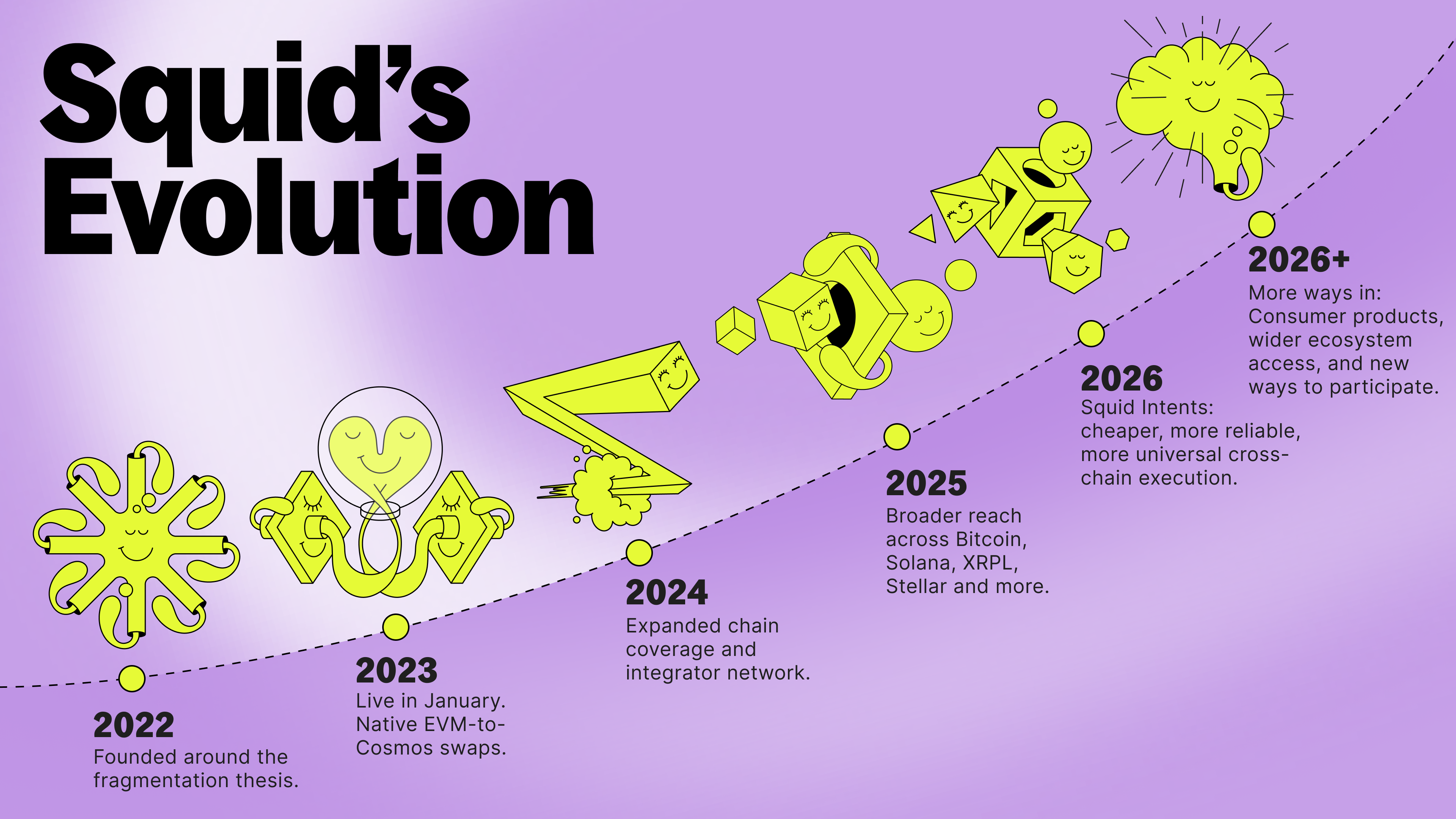
We started building Squid in 2022 because we anticipated the ongoing proliferation of new chains and new tokens would be the norm and that someone needed to connect all of them securely, in one transaction, without asking users to understand anything underneath.
The complete stack
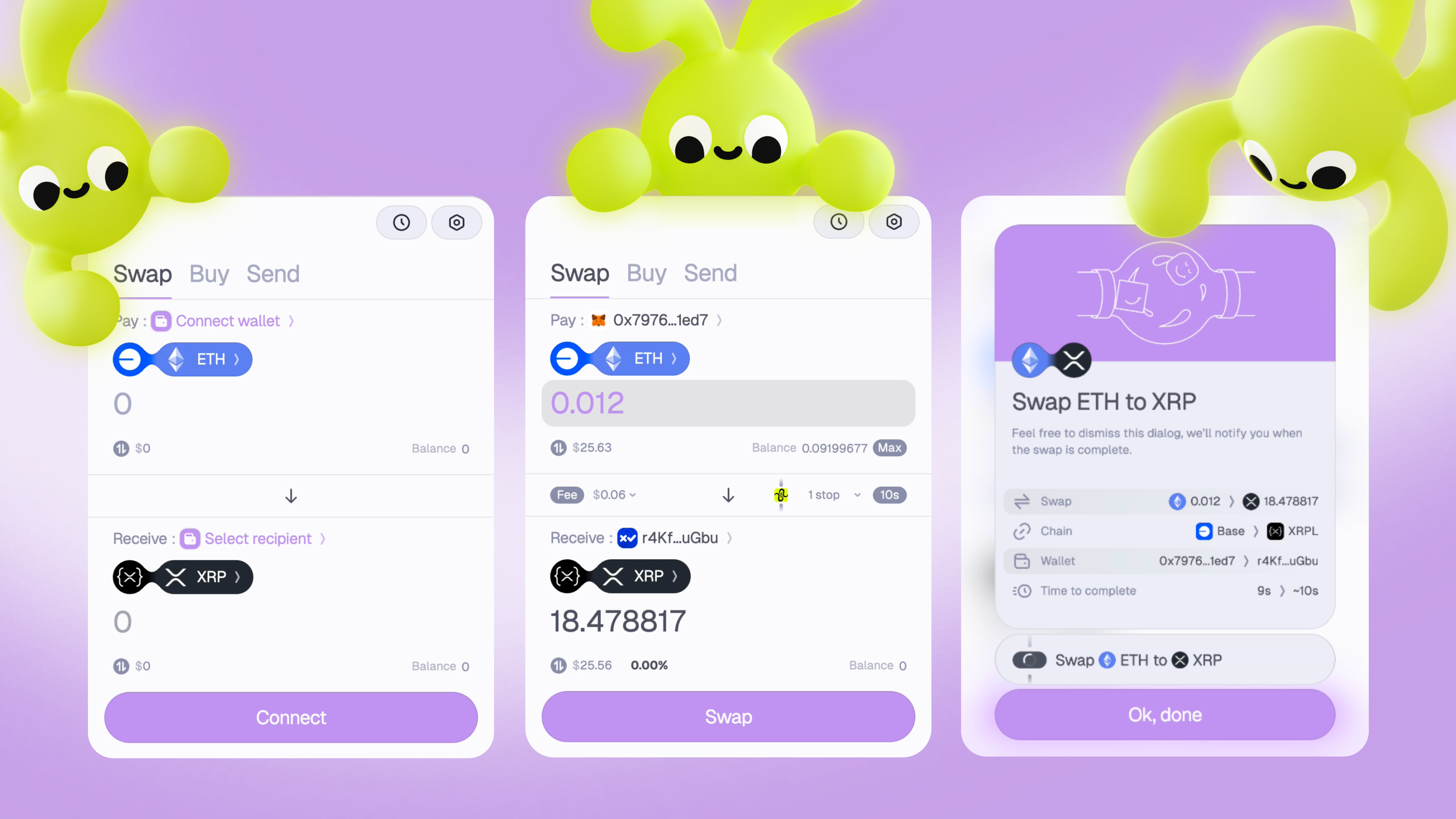
Squid is a settlement protocol, a routing engine, a developer toolkit, and a consumer product, built and maintained as a single system by one team. A user picks a token on one chain and a destination on another. Squid finds the optimal path across 130+ DEXs and offchain market makers then execute and settle the transaction in roughly five seconds. That simplicity is the product, and everything underneath exists to make it possible.
"People might know us from the interface, or from building on XRPL, or from being the thing inside their favorite wallet. But we build every layer: protocol, aggregation, developer tooling, consumer product. Most teams pick one. We do all of them, and that makes all the difference." — Fig, co-founder
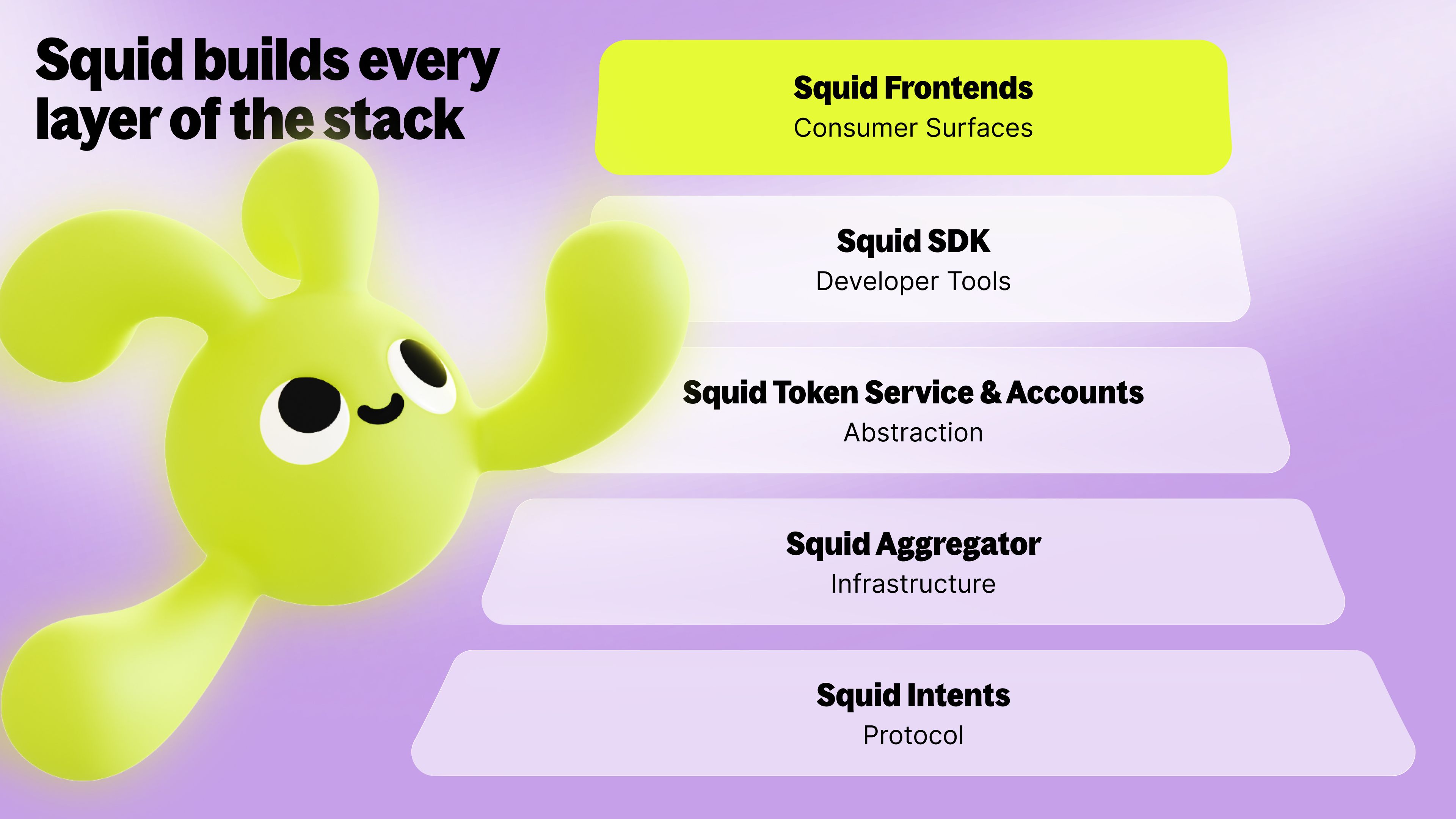
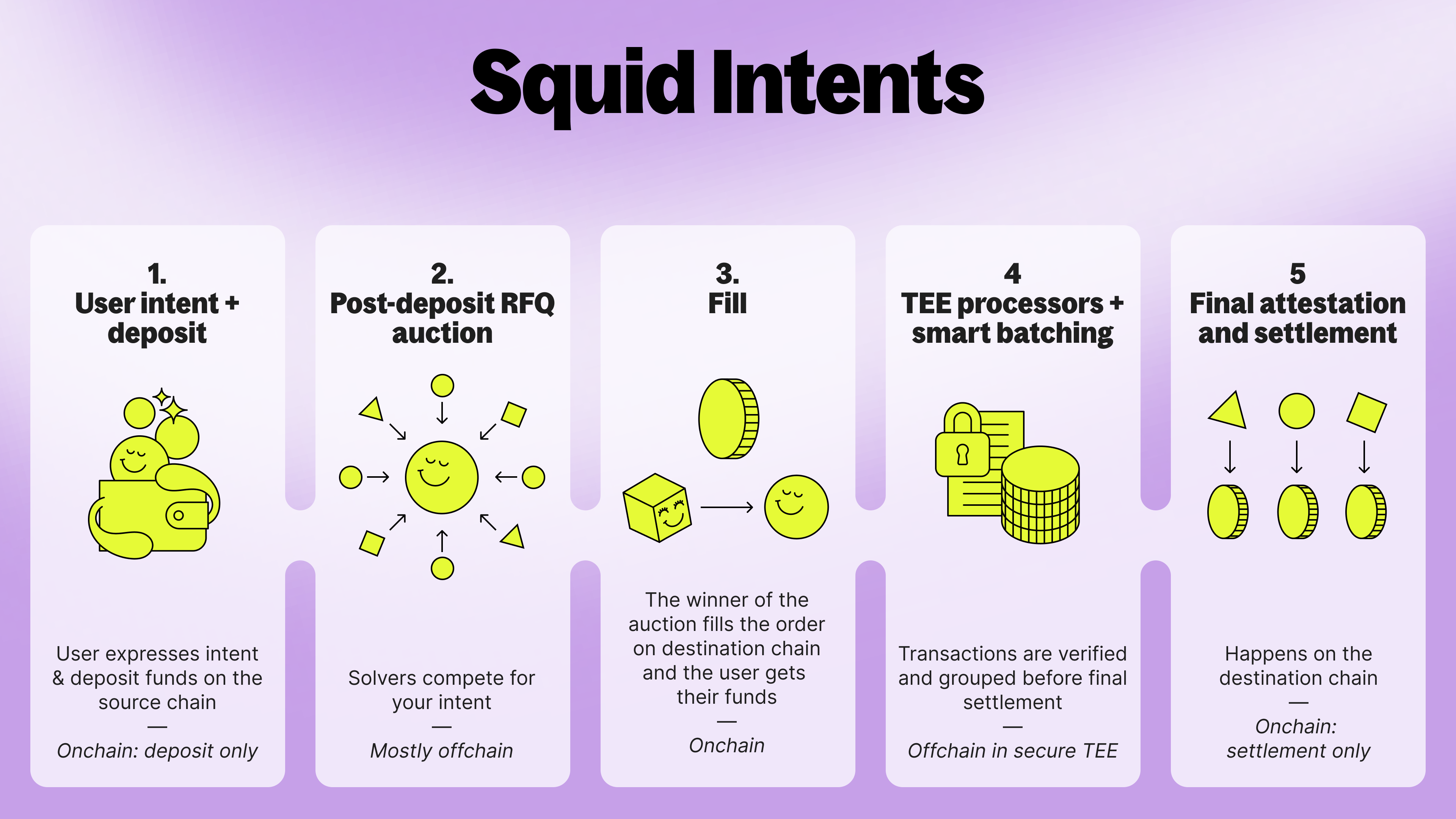
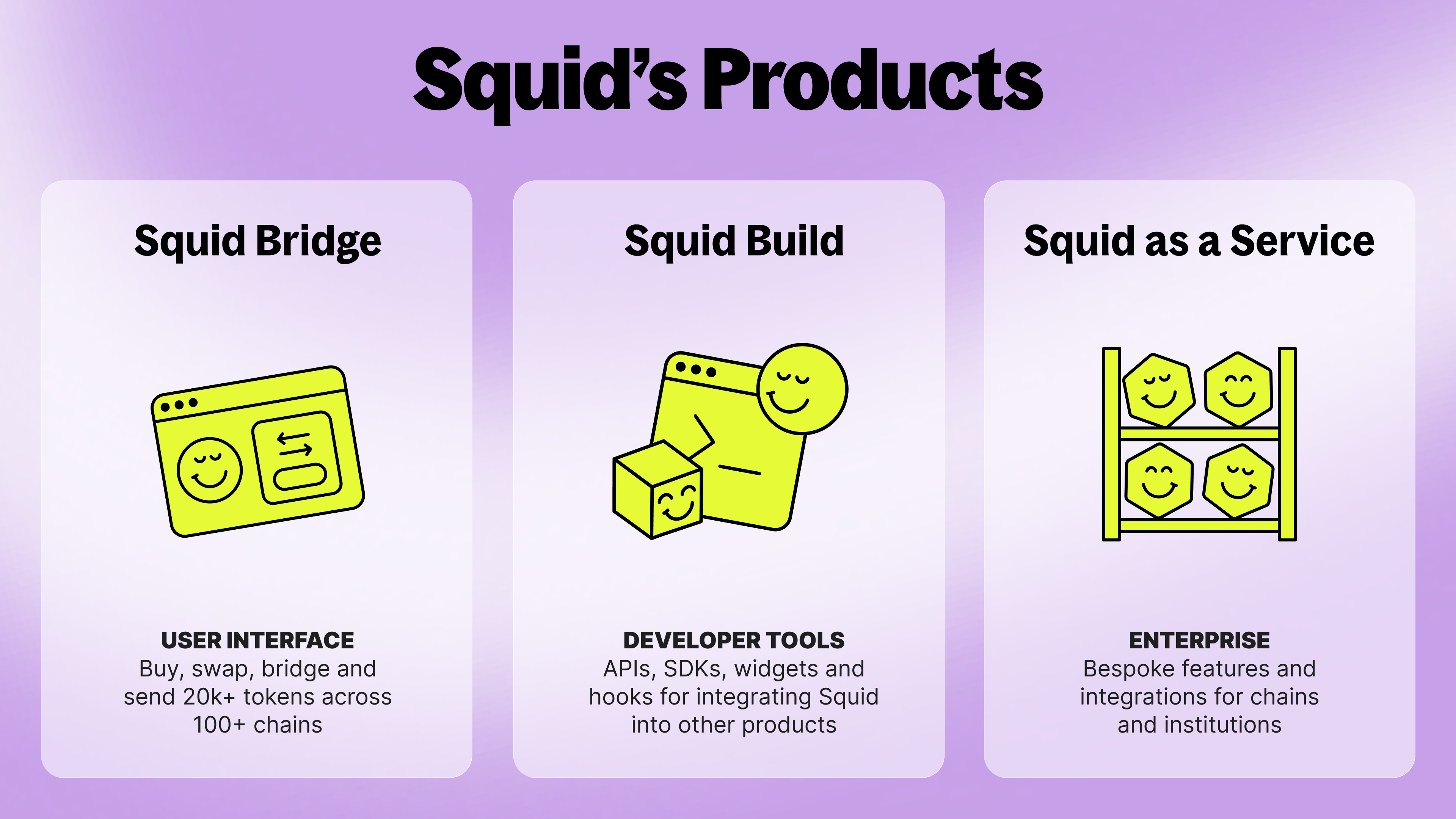
The stack has four layers, each built in-house. At the foundation, Squid Intents handles settlement: execution logic runs offchain in Trusted Execution Environments (TEEs), and only the final attestation settles onchain. Above that, the aggregation engine maintains a real-time graph of every token, bridge, and chain in the network, routing transactions across the cheapest and fastest path available. The developer tools (SDK, API, widget, and hooks) let any team embed cross-chain capability into their product, and the frontend app lets people choose for themselves which assets they want and where they want them.
That vertical ownership matters because we can fix, improve, or extend any part of the system without waiting on a third party. When we needed to support chains without smart contracts, we built a new execution layer to do it. And when we saw an opportunity in agentic payments, we shipped an MCP integration and an MPP adapter for Tempo within weeks.
Pushing the state of the art
Getting here took four major architectural iterations over three years. We started on top of Axelar in 2022, using general message passing to build the first solution for native asset swaps between EVM and Cosmos, a notoriously difficult integration across fundamentally different architectures. Years later, people still approach our founders at conferences to thank them for what they built. But the earliest version was limited: a few chains, slow finality, and high gas costs. We rebuilt the routing engine from scratch for V2, introducing a graph-based system that could tap into multiple bridge protocols, DEXs, and liquidity sources within a single transaction. Where V1 was locked to one messaging layer, V2 could combine Axelar, Circle's CCTP, Chainflip, and IBC in the same route, finding the cheapest and fastest path. A swap that previously required a user to bridge, wait, swap, bridge again, and swap once more collapsed into one click.
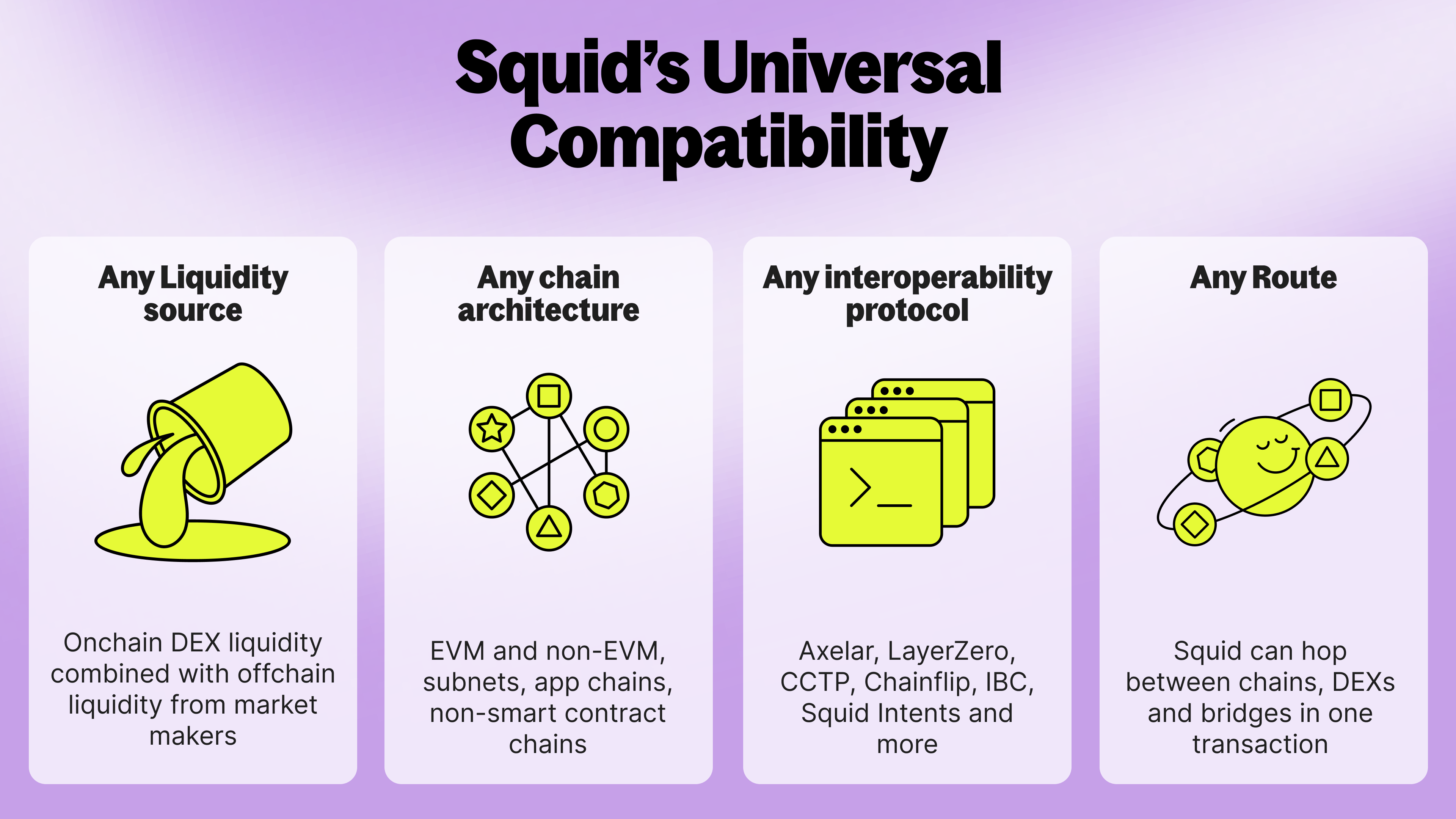
Intent-based execution came next, through CORAL (Cross-Chain Order Routing and Auction Layer). Market makers began competing to fill cross-chain orders directly, cutting gas costs by 90% and reducing execution to roughly five seconds. CORAL handled billions in volume and proved the model, but it still depended on smart contracts deployed on every chain, which limited us to ecosystems that supported them. Squid Intents removed that constraint entirely by moving execution offchain. The result is a protocol that can reach Bitcoin, XRPL, Solana, and any chain where assets live, with gas costs that drop as the network grows.
The early choice to pursue decentralization over speed came at a cost. Centralized competitors shipped faster in the early years. But it produced two things that compound over time.
The first is security: a non-custodial system that now matches centralized platforms on speed and cost, with a track record unmatched in cross-chain infrastructure.
The second is reach: because Squid connects permissionlessly to liquidity sources and chains rather than relying on bilateral integrations, every new protocol and token pair in the ecosystem becomes accessible without additional engineering. Coverage grows with the industry, and the industry is not slowing down.
"We took the hard route trying to build something decentralized. I'm glad that we've been able to make it work because now we're here, we've actually got the best solution out there and we haven't had to compromise on the original vision." — Fig
Connection is our north star
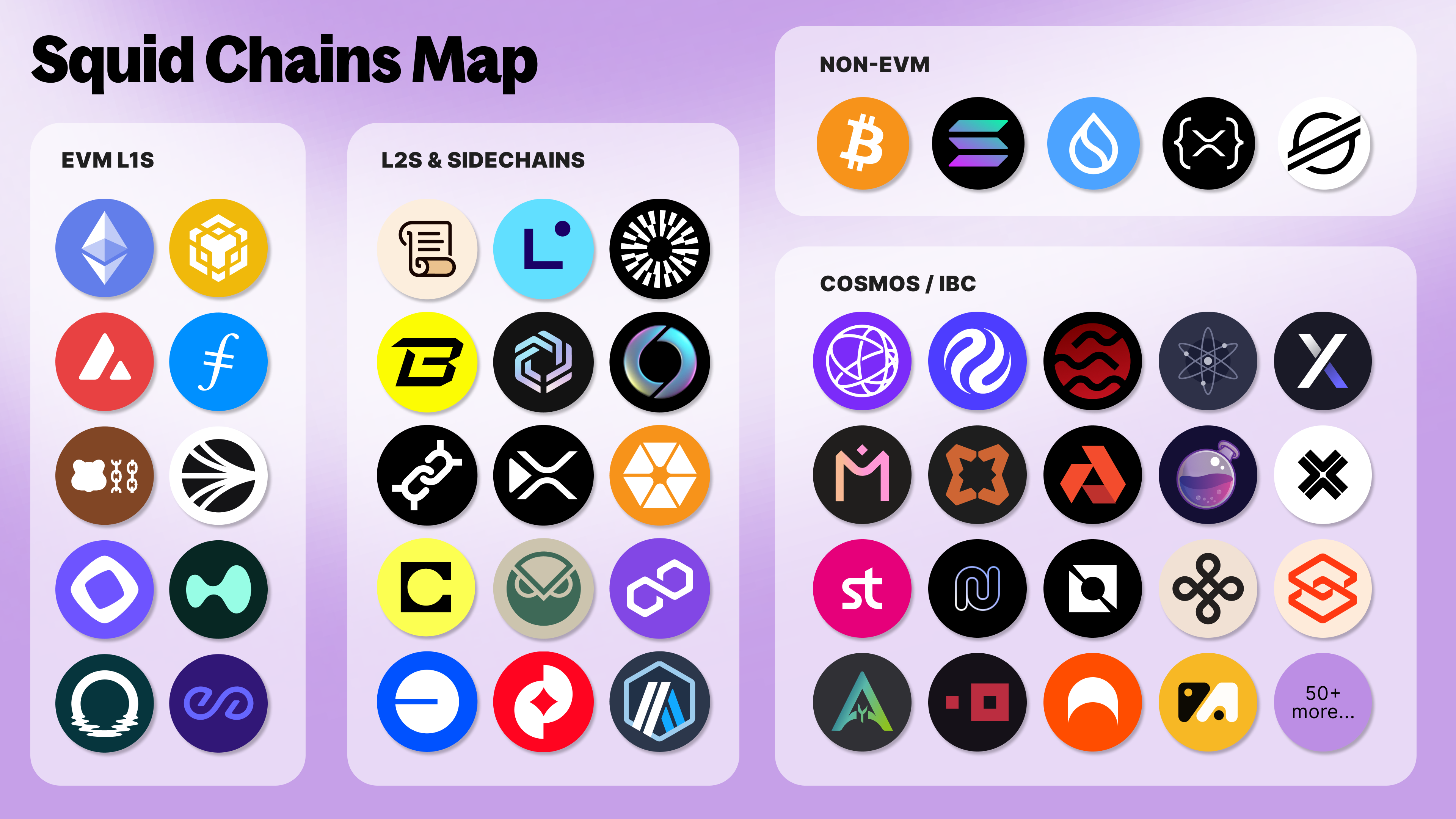
Most cross-chain protocols bridge within a single ecosystem. They connect Ethereum L2s to each other, or move stablecoins between EVM chains. This was the natural place to start, but we envisioned far deeper connectivity. Squid goes beyond, routing across fundamentally different blockchain architectures in a single transaction. The EVM, Cosmos, Bitcoin, XRPL, Solana, and Stellar each has its own transaction model, account structures, and execution environments. Connecting them requires deep, ecosystem-specific engineering, and the value of that work compounds: every new chain we add makes the entire network more useful for every existing user and integrator.
Squid's coverage today spans 100+ chains, 20,000+ tokens, and 130+ DEXs and offchain market makers unified into a single routing layer. A user can swap an ETH on Arbitrum for RLUSD on XRPL and experience the same speed and reliability as a same-chain swap. That includes chains without smart contracts, which most cross-chain solutions cannot support at all.
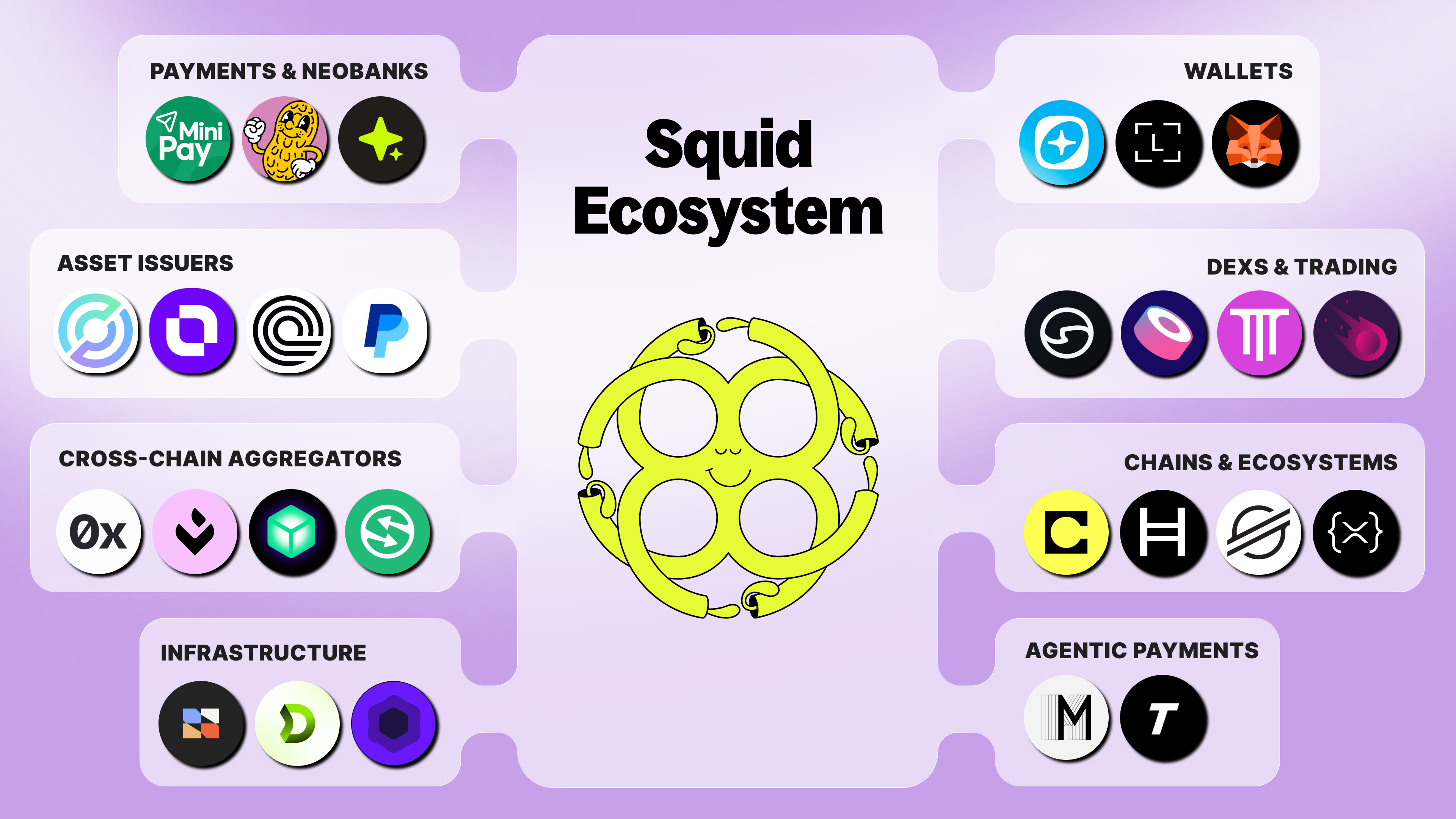
We connect chains as well as the teams and products building on them. The Squid Ecosystem spans the breadth of the industry: wallets (MetaMask, Brave, Keplr, Ledger), payments (MiniPay, Peanut), DeFi (PancakeSwap, Sushi, Pendle), and AI agents (Tempo MPP, Base x402). Many of the largest blockchain platforms have worked with us directly to connect their ecosystems to the rest of crypto:
The newest surface is machines. Five major agentic payment protocols have emerged in 2026, from OpenAI, Google, Coinbase, Tempo, and MoonPay, and Squid is already integrated with the infrastructure that powers them. When Tempo, the payments L1 incubated by Stripe and Paradigm, launched in March, we were there day one with an adaptor for their new MPP (Machine Payments Protocol), ensuring agentic payments can go to and from Tempo and other chains. Earlier this year we also debuted an MCP integration that lets AI agents execute cross-chain swaps through natural language. Automated commerce is projected to be worth trillions by 2030, and the cross-chain complexity that machines will face is the same complexity we have spent three years solving for humans.
Every crypto cycle produces new assets on new chains, and users need to reach them. DeFi summer sent people across Ethereum and its L2s chasing yield. NFTs sent them between marketplaces. Memecoins sent them to Solana, Base, and dozens of other chains. RWAs are drawing investors toward tokenized assets scattered across ecosystems. AI agents are initiating transactions that span multiple chains without human involvement. The narrative changes with every cycle. The need for cross-chain movement does not and neither does the desire for easier access to assets.
If you believe in crypto, then you believe in Squid.
Don't just take it from us
The platform has operated through every major market cycle of the past three years, from the FTX aftermath through bear market through meme coin mania through the institutional wave, processing over four million transactions and shipping consistently regardless of conditions.
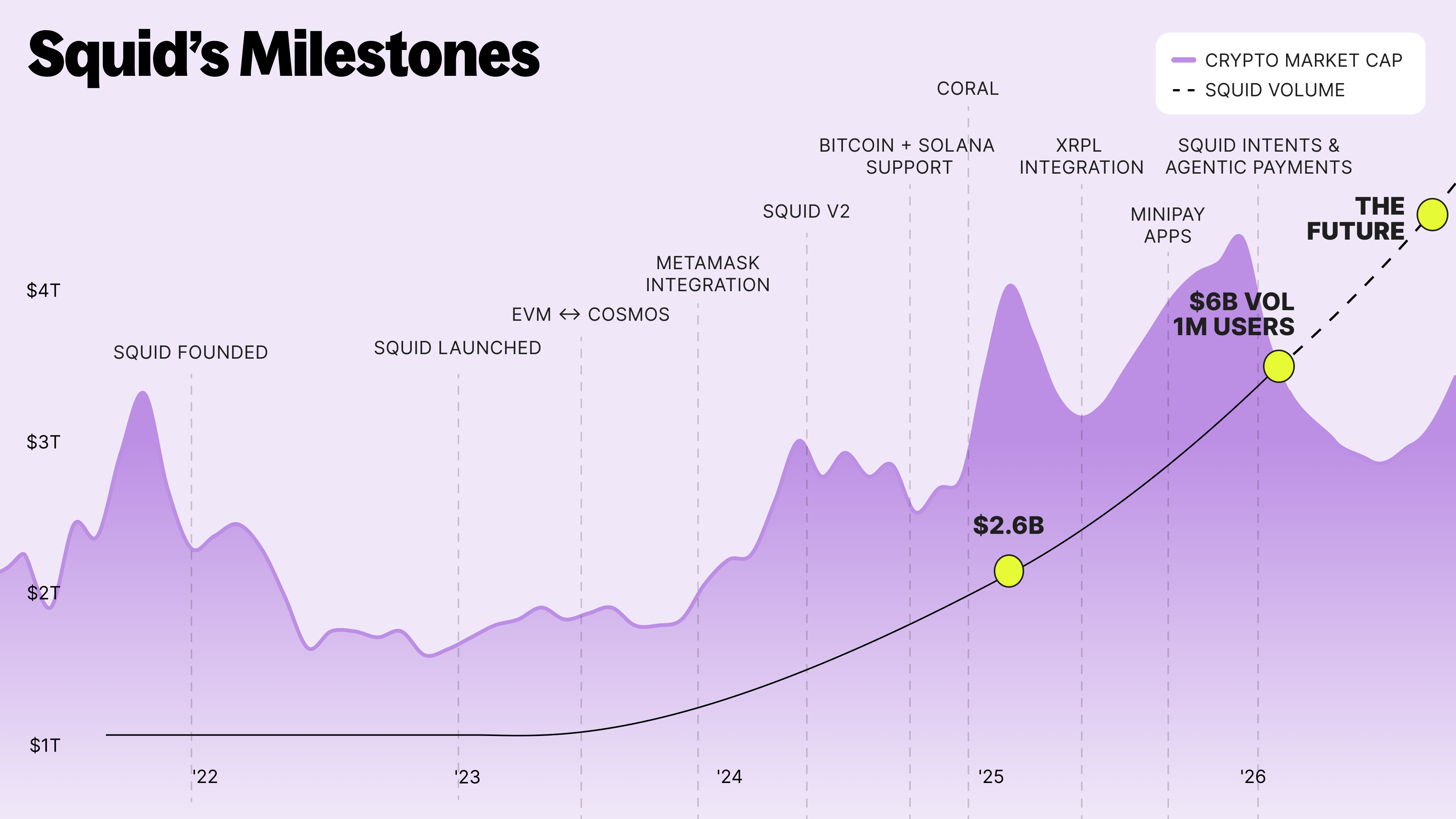
A majority of that volume flows through our own frontend app, which means the platform is tested against real consumer behavior every day. The rest comes through partner integrations, and the growth pattern ties directly to product milestones. When XRPL went live, a new ecosystem of users and builders gained access to cross-chain liquidity for the first time. When Opera MiniPay’s user base across the Global South expressed interest in buying gold digitally, we launched a MiniApp that’s seen such use that we followed with MiniApps for buying key cryptoassets. Three partnerships illustrate how Squid grows through tailored service to unique communities.
On XRPL, we entered a community known for being skeptical of outsiders by doing something most cross-chain protocols skip: participating in governance. We applied to run a UNL validator, engaged with community leaders before writing a line of XRPL-specific code, and built relationships over months. The result is a full-stack ecosystem presence, including the first cross-chain XRP and deep integration with Ripple's growing asset ecosystem.
"You guys had the absolute best go-to-market out of all projects that entered the XRPL from an outside perspective." — Krippenreiter
Peanut integrated Squid before it even launched. The team needed cross-chain payment links that let a sender share a $5 link without caring what chain the recipient is on (or even if they use crypto). Our SDK handles all of the routing and pricing underneath, invisible to the end user. The integration was live from day one and has grown alongside Peanut's product.
"Squid does all of the sophisticated routing and finding the best price and best speed, which allows us to have the seamless experience of cross-chain payments." — Konrad Urban, co-founder at Peanut
MiniPay is the most instructive case for what comes next. Opera's mobile wallet serves users across the Global South, and when the team wanted to offer gold and crypto trading inside the wallet, we collaborated on the product design itself, building bespoke swap flows and DEX aggregation tailored to MiniPay's interface and user base. The integration runs on Celo, demonstrating that Squid's routing and aggregation engine is useful even within one ecosystem. 88,000 users and all-time high transaction volume followed in March 2026.
"If you're looking for a strong partner that wants to turn complex blockchain infrastructure into a simple, user-friendly product, I don't think you should look any further." — Murray Spark, Head of Commercial & BD, MiniPay
The partnerships that drive Squid's growth are built the old-fashioned way, through showing up early, listening to what a team actually needs, and staying involved long after launch.
"Now we have, and we've had for years, product-market fit, which I think 99% of crypto companies can't say." — Christina, co-founder
Our growing revenue
Squid generates revenue today from two sources, with a third being implemented.
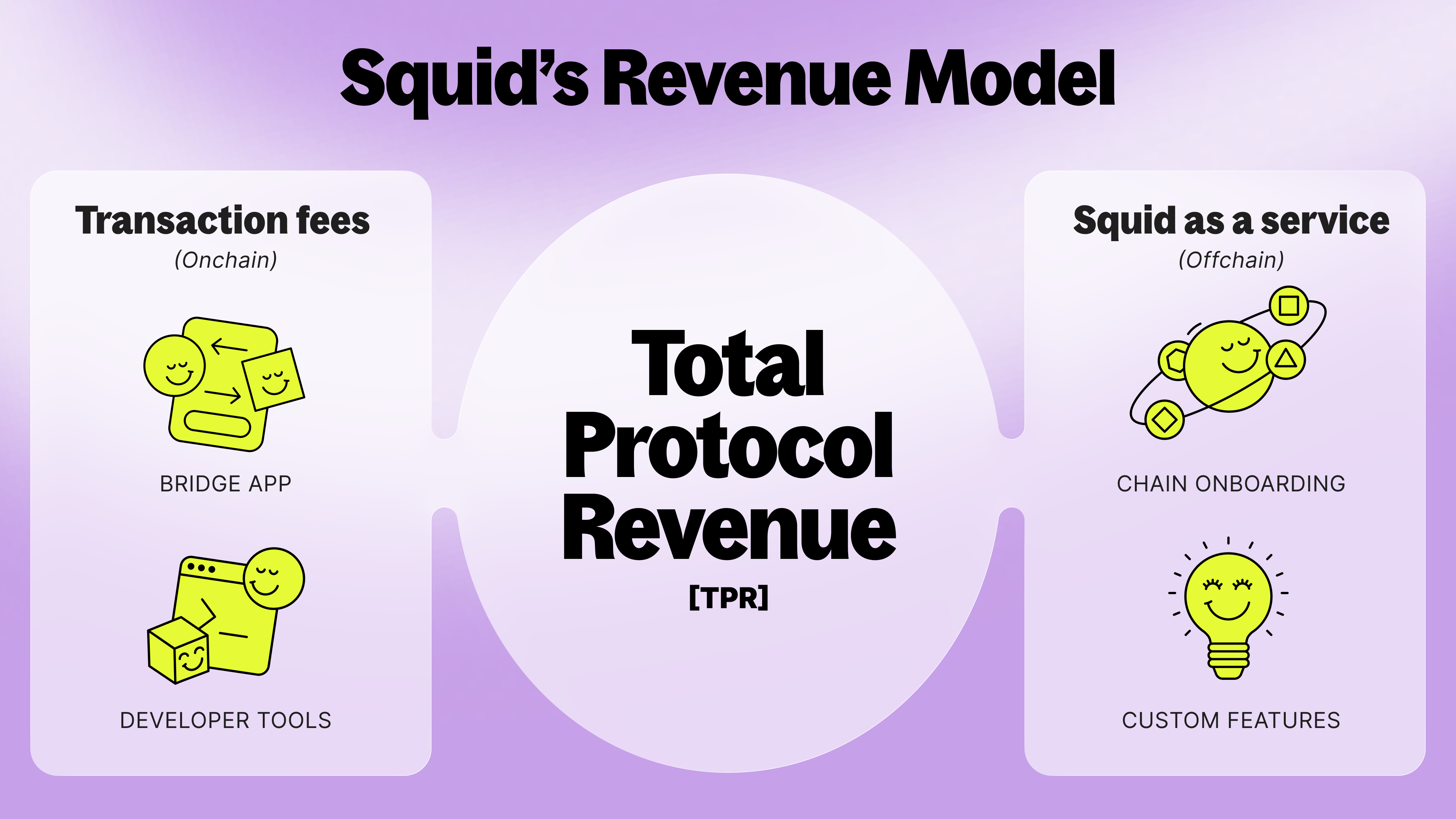
When integrators embed Squid into their own products, the fees their users pay are split between the integrator and Squid. This revenue scales with integrator volume. Enterprise services generate a second line: chains and ecosystems pay Squid to connect them to the rest of crypto, gaining immediate access to liquidity and cross-chain distribution. XRPL, Stellar, Hedera, and Celo have all contracted Squid for ecosystem onboarding, and bespoke integrations for partners with complex cross-chain requirements make up a growing share of income.
The largest revenue surface will soon be switched on. A variable convenience fee is being implemented on our frontend volume. The fee scales with the volatility of the assets involved and the complexity of the route: stablecoin-to-stablecoin swaps carry lower fees, volatile and long-tail tokens higher ones, and chains that are harder to reach through other means carry a surcharge. Because market makers compete to fill every order through Squid Intents, users already get the best available execution price, and then the convenience fee sits on top of that optimized price. Stargate and deBridge, protocols with comparable volume bases, have turned on fees and now generate millions in annual revenue.
As we develop a new way for people to use Squid, more revenue sources will emerge.
Security
Bridge exploits have cost the crypto industry billions. The list of protocols that lost user funds through security failures is long, and these losses have shaped how the industry evaluates cross-chain infrastructure. Squid was founded in the middle of this. The choice to first build on Axelar, the most decentralized and secure messaging layer available at the time, was a security decision as much as it was a product decision.
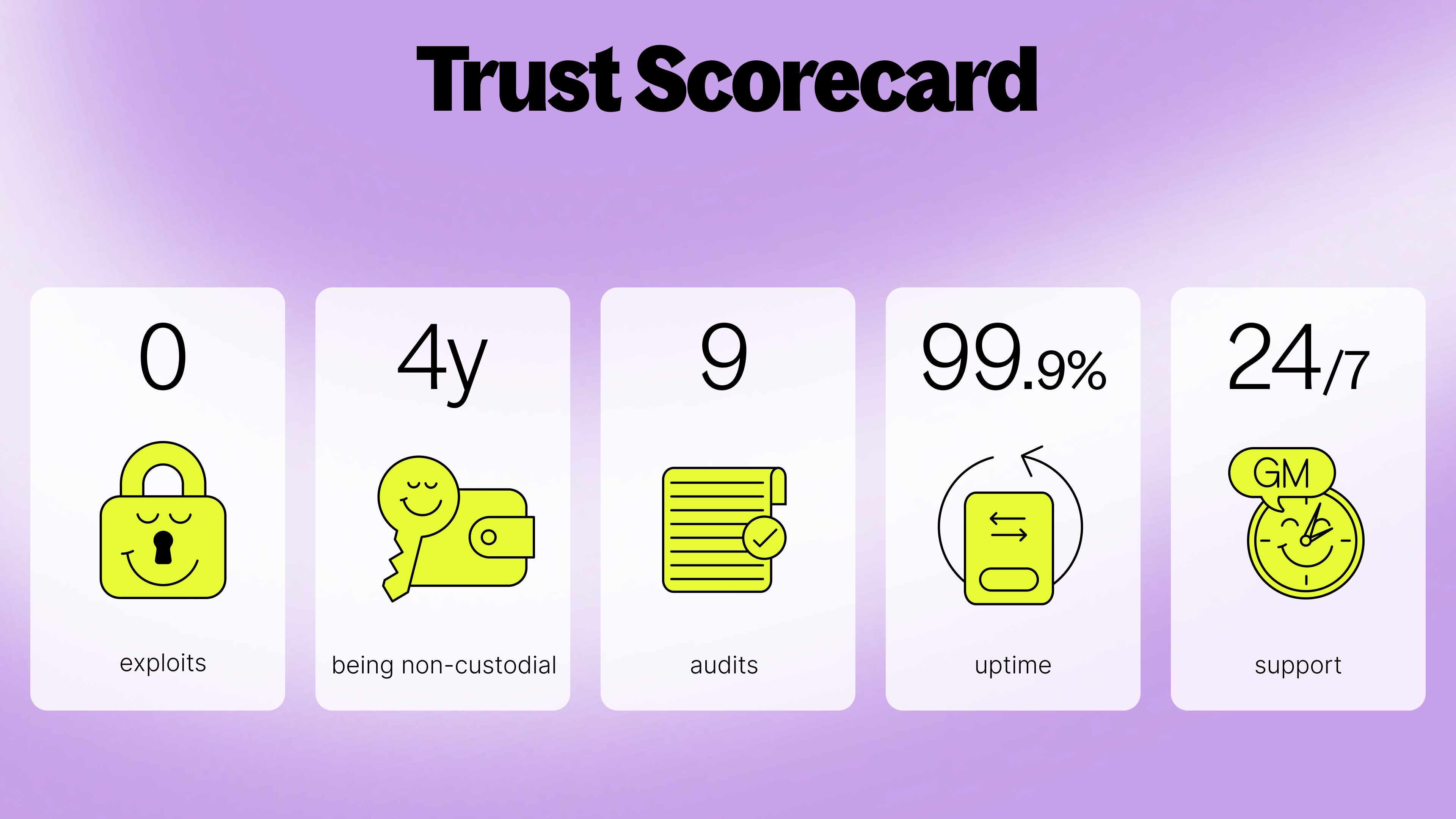
Squid is non-custodial, with users maintaining control of their keys and assets throughout every transaction. This has been a constant since launch. Further, the platform has completed nine security audits, maintains 99.99% uptime with 24/7 support, and has recorded zero exploits in over three years of live operation.
Squid Intents reduces attack surface by moving execution logic offchain into Trusted Execution Environments (TEEs) while settling only the final attestation onchain. Less onchain complexity means fewer vectors for exploitation. Market makers compete to fill orders within the TEE, and only the verified result touches the chain.
"Safety is user experience. We love hearing from people who delight in using Squid, and for that to happen they must first feel safe." — Fig
Squids and Supporters
Squid was founded by Fig, Christina, and Koda. Fig and Christina met in 2020 through the crypto community while both were working on decentralized derivatives. Fig met Koda earlier while they were both working in traditional finance in Australia. Fig's background spans medicine, self-taught programming, venture capital, and family offices. He has lived nomadically for over a decade and leads protocol and product development.
Christina studied business as an undergrad and philosophy and public policy at LSE, worked in London's health tech startup scene, and entered crypto full-time in early 2018. She leads business, strategy, and partnerships.
Koda oversees the backend routing infrastructure and helps drive technical strategy across the protocol. Before crypto, he spent years leading teams building big data and machine learning solutions for banks and mining companies.
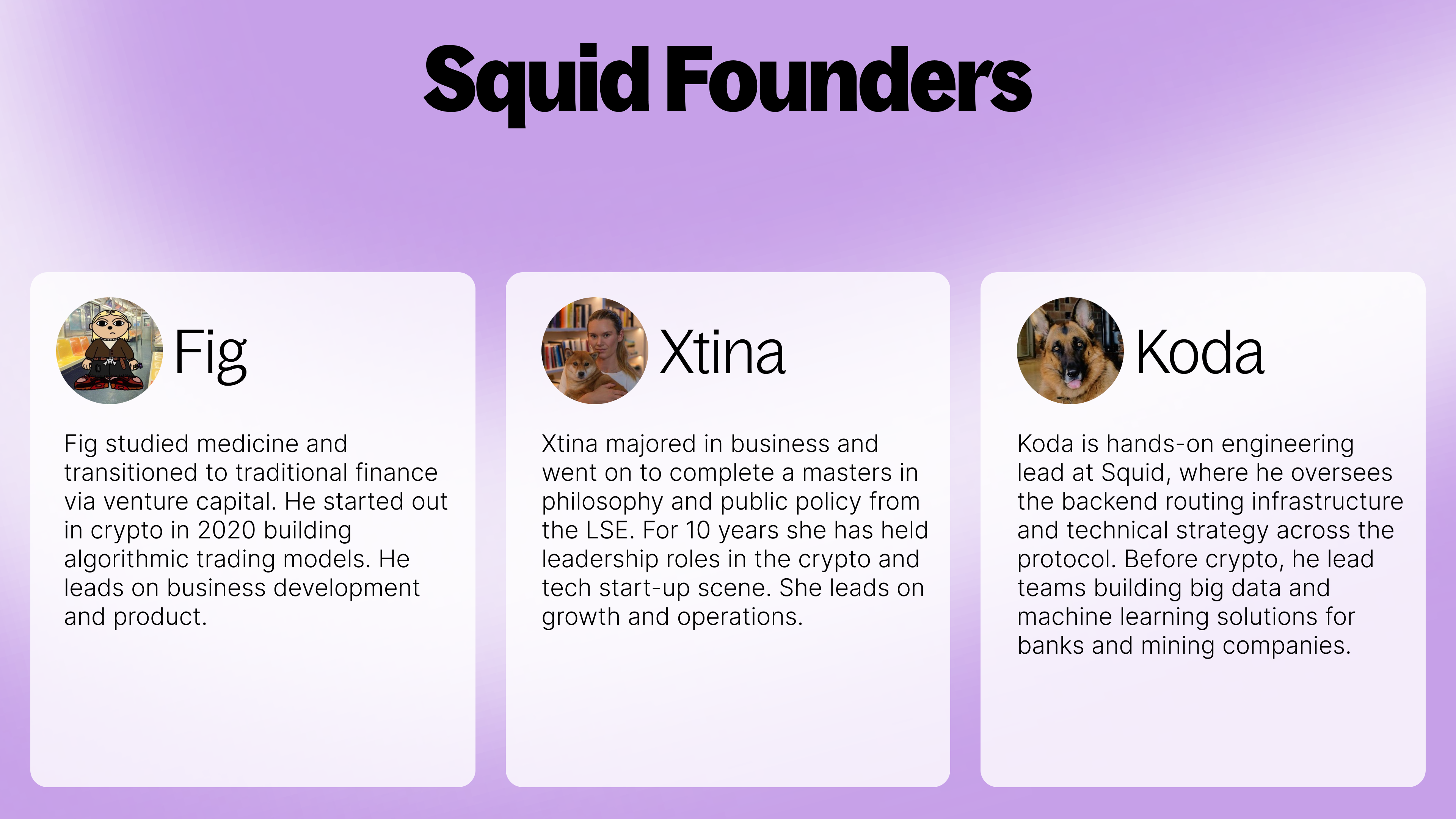
The team is roughly twenty people, globally distributed and fully remote. Both founders share a sensibility around taste, aesthetics, and care that filters into hiring, product design, and brand. Squid does not look or sound like other crypto infrastructure companies, and that's deliberate.
"It's really important when you find your co-founders that you have a relatively similar take on taste. Taste is not necessarily what crypto is known for, and that is something we agreed from the start we wanted to be known for." — Christina
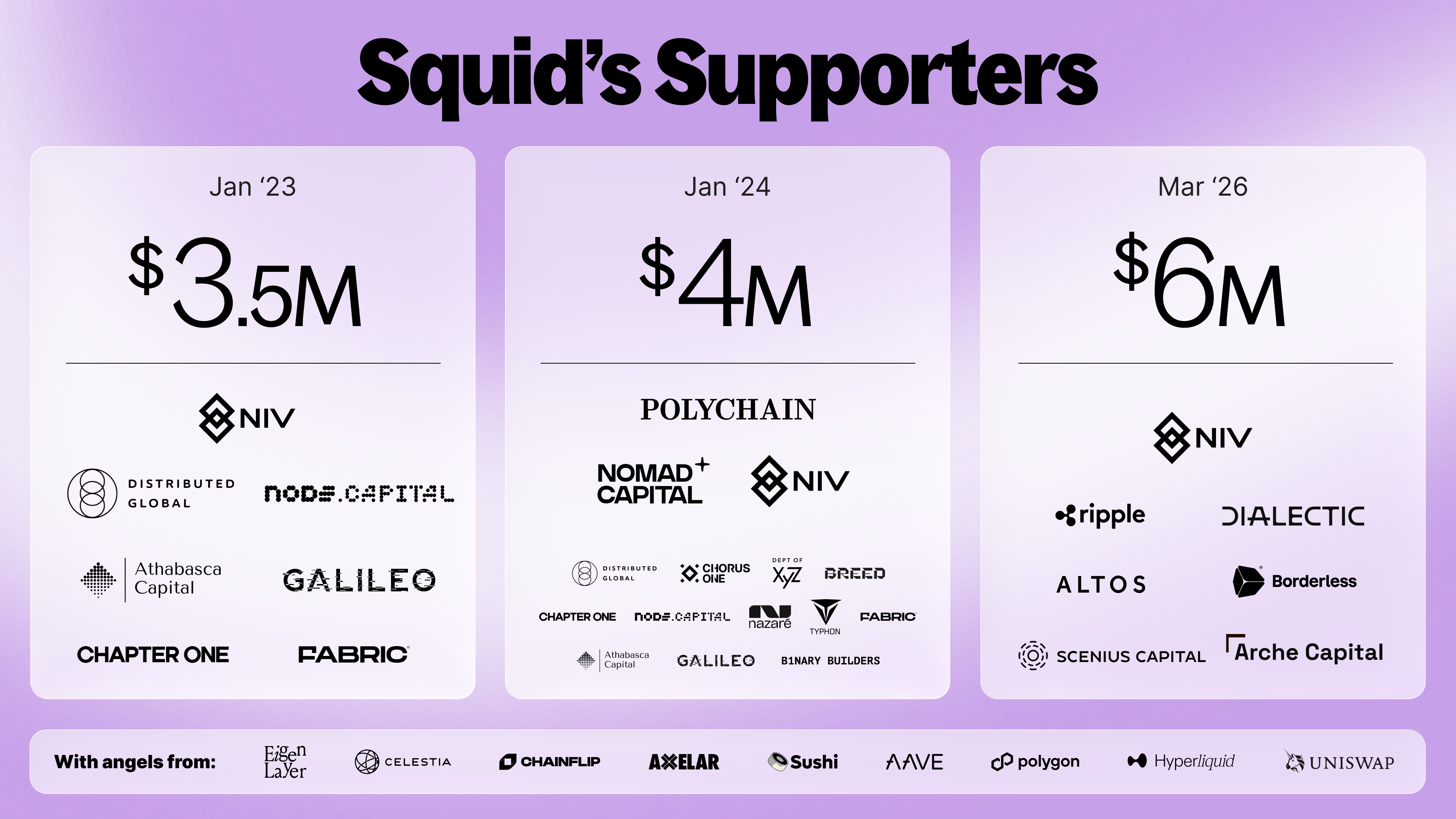
Squid has raised $13.5M across three rounds. North Island Ventures led the seed in January 2023. Polychain Capital led the strategic round a year later, joined by Maelstrom, Chorus One, and angels from Aave, Hyperliquid, Sushi, and EigenLayer. North Island returned to lead the most recent round, which brought in Ripple, Avalanche, Greenfield, and included angels from Ledger and Axelar. We're proud of our progress that has inspired many of our investors to return across multiple rounds.
The culmination
The infrastructure layer continues to grow. New chain integrations, new ecosystem partnerships, and new surfaces for agentic payments are all in progress.
We are also building something new. For the past year, a significant portion of the team has been working on a consumer product built on everything Squid has created: the routing engine, the aggregation layer, the cross-chain settlement, and the integrations across 100+ chains. All of it becomes the foundation for something designed around how people actually want to interact with their money. You'll be hearing more about it soon.
"Fees will compress. Features don't differentiate any more. What is left is three things that are forever: UX is forever. Relationships are forever. Brand is forever." — Fig
We hope you'll join us in this next chapter.
About Squid
Squid is a cross-chain platform connecting networks, liquidity sources, and applications to power the seamless movement of digital assets across crypto. Squid’s frontend app can be used to buy, swap, bridge, and send 20k+ tokens across 100+ chains, tapping into 130+ liquidity sources in a single transaction. Developers can integrate Squid via SDK, API, and Widget to enable cross-chain functionality within their own products, and Squid is trusted by 1,000+ integrators today.
Please Note
This blog is provided for educational and informational purposes only. This is not investment advice or a recommendation or solicitation for on-chain participation in any mentioned chains, tokens, or assets. Please do your own research before swapping any on-chain assets.