
The Story of Squid
The Story of Squid
From one chain to one hundred, one integration to one thousand, one token to twenty thousand, there has been only one entity that has remained singular in these past three years of growth, and that is Squid.
You know us as a friend, a colorful face amidst the dark sea of DeFi. We are the first place you go when trying to reach a niche chain, perhaps your last resort when desperately trying to sell that airdrop you received.
Squid is bright because we light the path for everyone. We are not built for one time or one place, we are built for all. Our history is yours, it always has been. And our futures? Well, they’re the same.
Because we’ll be there for the lows, the highs, the in betweens. We’ll be the point between two places, just as we’ll be there at the start, at the end.
When you think of Squid, think of everything.
Think of the bridge that gets you wherever you need to go. Think of the ecosystem that connects all of your favorite projects, the tool that powers each and every app, the platform that is full-stack. Think of the constant flow of liquidity that reaches far and wide, that taps into exactly the right pools to get you exactly the right price.
Think of EVM, non EVM, SVM, and non-smart contract chains too. Think of functionality that exists on one single chain as it does across hundreds.
The possibilities are endless with Squid, because Squid wasn’t built for yesterday or today. It was built for tomorrow, and each day that follows.
We launched in January 2023 with a mission to fix multichain fragmentation.
Since then, we’ve introduced novel methods as a solution, enhancing our product each step of the way.
Join our walk down memory lane as we recap how we got where we are now, how the Squid Stack evolved and what it all means for the future:
Squid's origin story
Let’s go back to 2022, the year that Squid was conceptualized.
Crypto was rapidly becoming multichain, and there was no easy way to move assets across networks. Bridging took money and time, not to mention sheer mental drain. Where there was a proliferation of chains and ecosystems, there were equal limitations to innovation. Build the app, but then what? With fragmented liquidity and an all but frightening user experience for people investing real money, the industry came face-to-face with the consequences of growth before connection.
Let’s not forget the era of canonical bridges, native tokens as the sole method of payment for fees, more wrapped assets than not, and the fact that you more than likely still have tokens somewhere, drifting between chains, so long forgotten that they have started to gather dust (in the metaphorical sense). How do we know? Because we, too, were there. We feel your pain.
It’s why we built Squid, and launched it in January of 2023. Born out of a simple observation, and the desire to fix what needed to be solved, rather than create something temporary.
We started by connecting Ethereum and then Cosmos. But why stop there?
The architecture of Squid V1 was built with the future in mind, so that we could grow and morph into a layer of connectivity that stretches far and wide. When we release new features and upgrades, the core of Squid remains. Our essence is a vibe, but it is also that original idea that turned real.
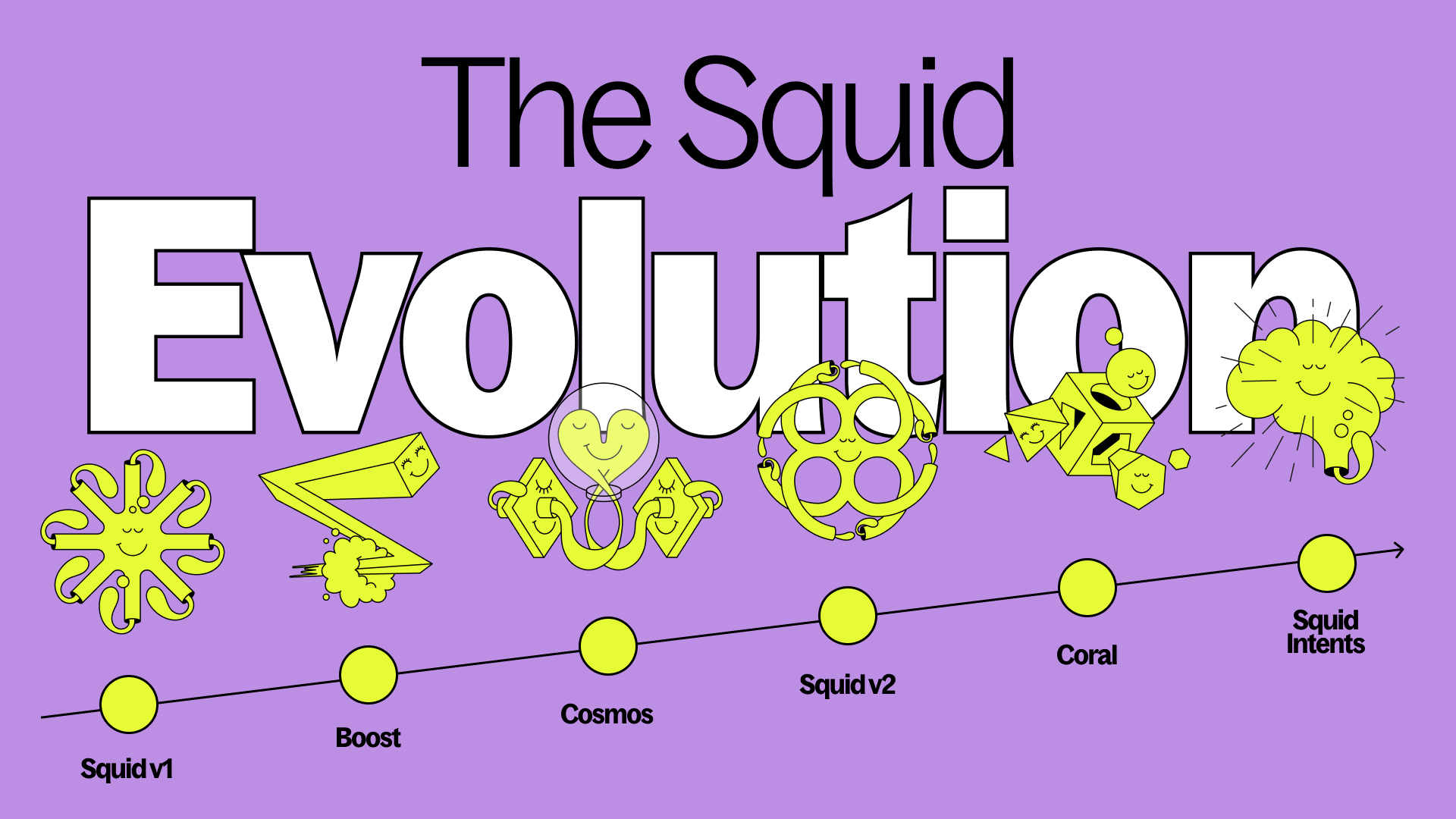
That’s the story of our mission. Now let’s get specific with what we’ve accomplished so far.
Squid V1
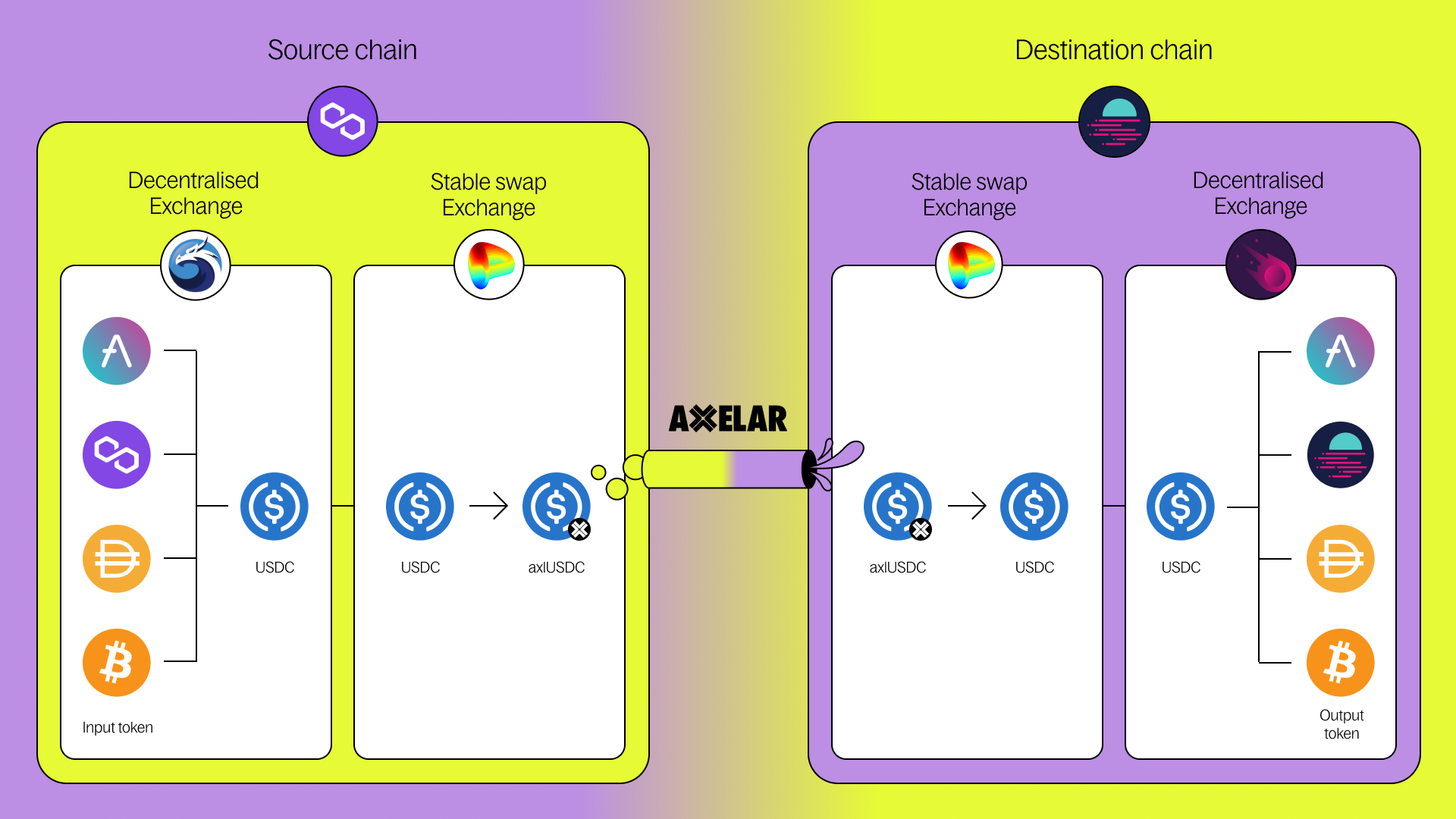
Squid V1 was built on top of Axelar and used Axelar’s General Message Passing (GMP) technology. The earliest version of Squid was merely an API that allowed users to interact more seamlessly with Axelar, thus accessing and moving their assets across a limited number of chains. We started by connecting EVM networks like BNB Chain, Ethereum, Arbitrum, Moonbeam, as well as connecting Ethereum chains to Cosmos via Axelar’s bridge.
Our initial Cosmos support was limited, allowing axlUSDC bridging between EVM chains and Osmosis. Axelar had native compatibility with Inter-Blockchain Communication (IBC), which we later added for inter-Cosmos connectivity. We used Osmosis as the liquidity hub, so you could bridge to Osmosis, swap from the axlUSDC to other assets, then IBC over to other Cosmos chains.
What did this look like?
We connected EVM chains via Axelar to Osmosis, then did a swap from Osmosis liquidity pools to other tokens on other Cosmos chains via IBC. Routes could now include multiple IBC hops before or after EVM swaps… But get this, it was all completed in a single transaction.
Squid worked out the best rate with a simple path finding algorithm. It broke every transaction into route exploration, quote and encoding the swap. Under the hood, routes usually looked something like:
Original token → native asset → stablecoin → axlUSDC → Bridge → Stablecoin → native asset → destination token
To you, the user, it looked like one simple click, swap, and complete.
And just like that, we’d automated the cumbersome manual bridging process.
What started as an API shifted into something more. We released our frontend as a demo only to realize our team had a natural talent for frontend UI/UX. Not only that, but projects began requesting our widget as an integration for their frontend.
Our next goal became solving the problem of speed. With the technical foundation already in place, we were going to make cross-chain swaps instant. Enter Squid Boost.
Squid Boost
Squid Boost was our first attempt to improve speed. Minutes became seconds, saving users hours of their day that would have otherwise been spent waiting for their tokens to be bridged.
Instead of waiting for a bridge to finalize, relayers would front the liquidity instantly and complete the transaction for the user. When the bridge was finalized, the relayer was repaid.
Boost was originally an option you could click to expedite your swap, but it was so efficient, cheap, and reliable that we integrated it into the core experience so that everyone got to benefit from it.
It also introduced a concept that would become central to Squid later: intent-based execution.
Instead of forcing every step to happen sequentially onchain, the system allowed external actors to fulfill the user’s intent more efficiently. The UX improved dramatically, yet costs were still high…
More chains, more ecosystems
At the time of Squid Boost, we’d reached dozens of chains and ecosystems. From EVM, to Cosmos IBC. We’d added support for more than 70 chains across Ethereum and Cosmos, with each new chain creating challenges that only drove our core mission further and further.
We had a web of chains connected, it was like a living organism with a heartbeat. The larger the web, the longer it took to find optimal routes. Our original architecture bore the weight of a system that could not sustain this rate of growth. A good problem to have.
At one point or another, all V1s must come to an end. This is the beauty of success, growth, and a team that faces each challenge head on.
And so our next goal became Squid V2.
Squid V2: Rebuilding the engine
Squid V2 was a full architectural redesign. Core changes to the protocol were done to address the issues of system complexity and scalability. We introduced a novel approach to cross-chain interoperability called multi-protocol hopping, a sophisticated graph based routing designed to “hop” between DEXs, bridges, protocols, and liquidity pools.
We integrated Circle’s Cross-Chain Transfer Protocol (CCTP) for stablecoin bridging, and we also integrated Chainflip for Solana and Bitcoin support. These added to our existing integrations of Axelar and IBC, which amounted to four separate protocols for us to tap into within a single route.
Squid V2 and multi-protocol hopping exemplified fluidity of passage by enabling simultaneous use of multiple protocols in one transaction. Unlike other solutions that were restricted to one protocol, Squid V2 was able to tap into DEX liquidity anywhere within a route in order to complete and execute a complex order in a single click.
Here’s a look behind Squid V1 and Squid V2:
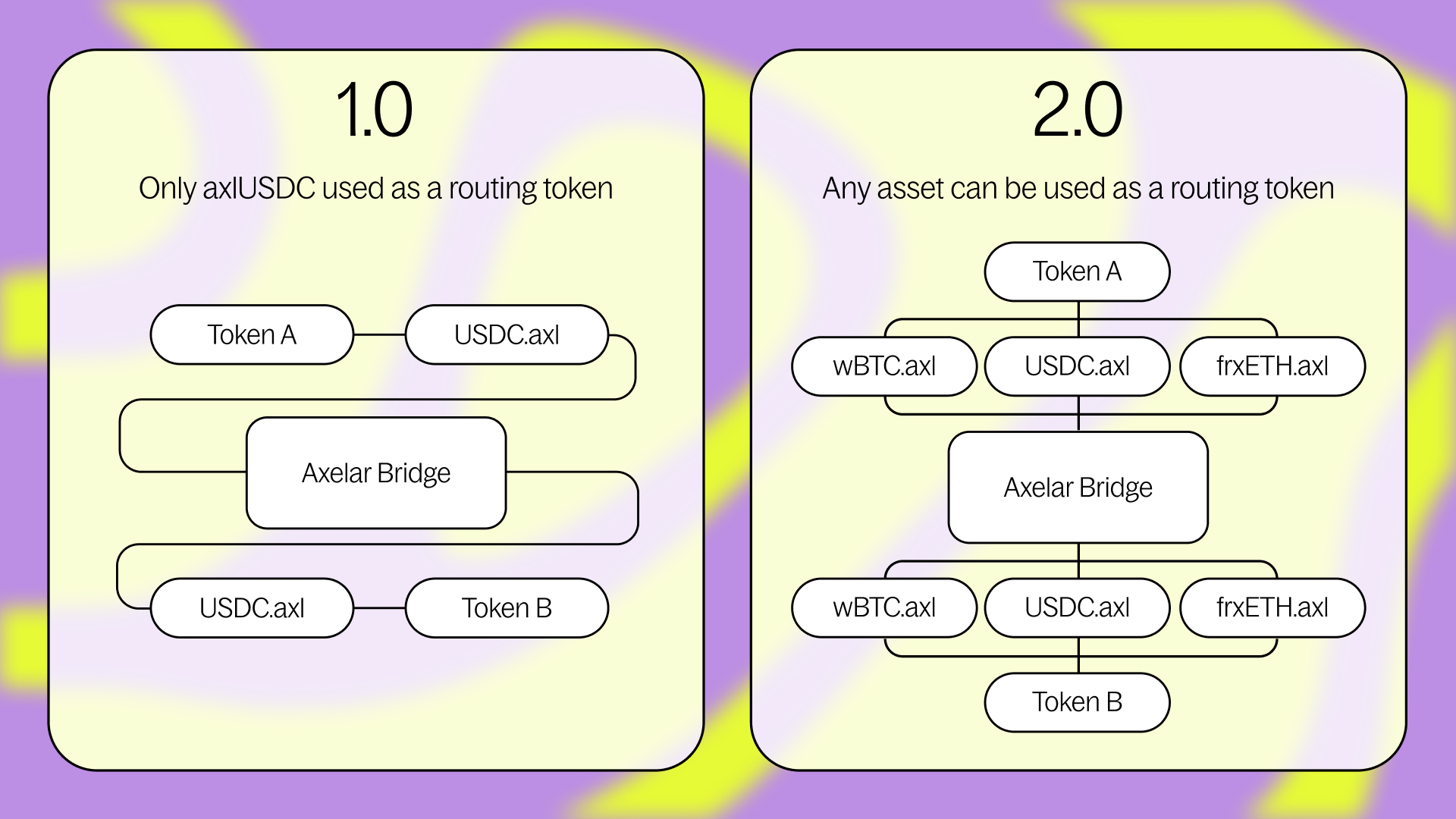
Our V2 dramatically improved performance. Squid got faster quotes, lower overall infrastructure costs and could support more bridge types. We had solved a major issue in fragmentation, but there was still a problem we hadn’t solved: gas costs.
Introducing CORAL
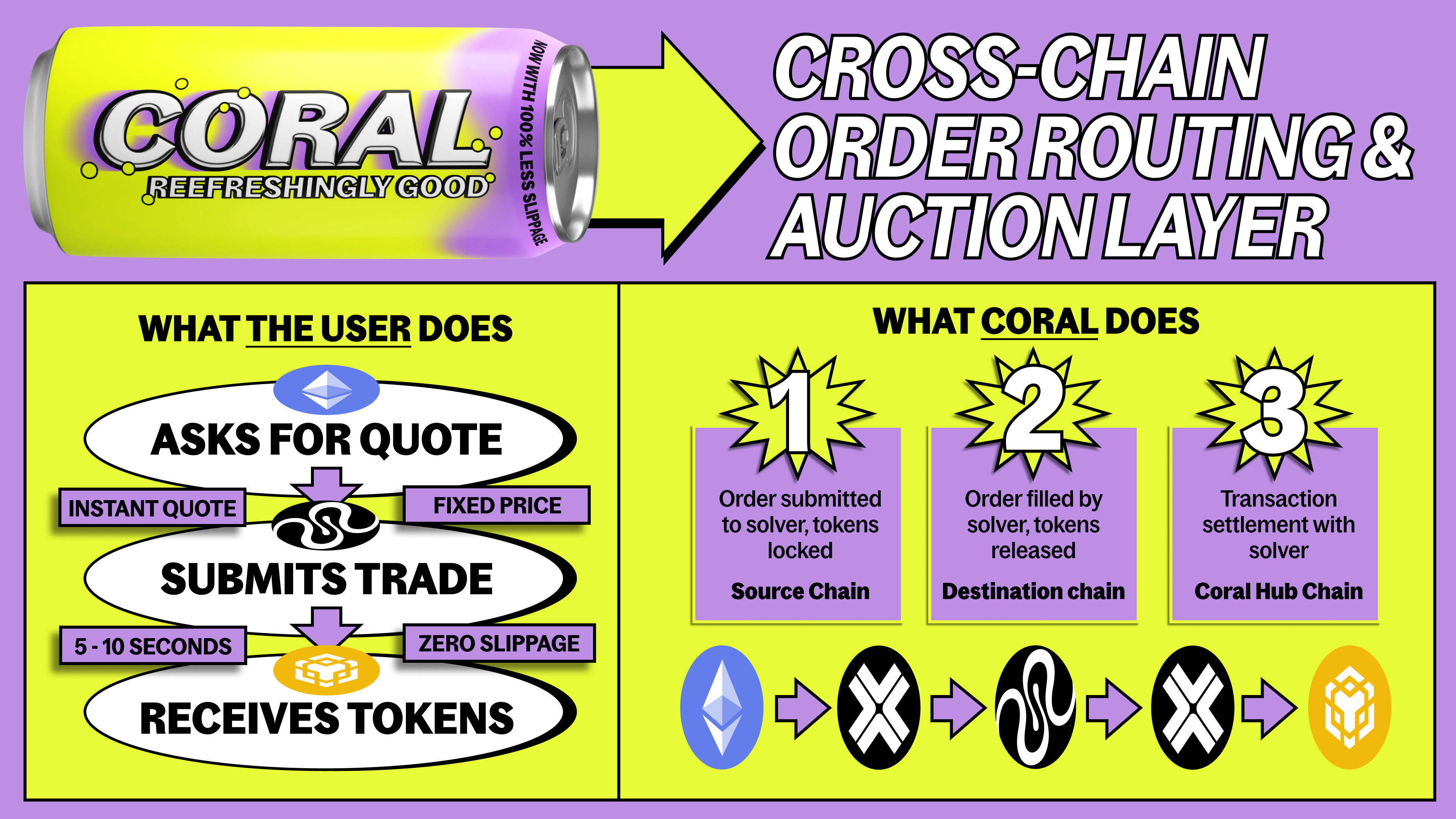
What is CORAL, you ask? Why, it’s our Cross-Chain Order Routing and Auction Layer.
Our better than magic, intent-based system that combines offchain liquidity with 110+ onchain liquidity sources through Request-For-Quote (RFQ) auctions!
We had solved routing, yet why stop there? (Are you sensing a theme?) Swaps still relied heavily on AMMs and bridge messaging systems. This meant multiple transactions, gas fees at each step and multiple failure points.
Our solution to this was CORAL, making Squid a complete intent-based protocol.
CORAL introduced intent-based execution using RFQ auctions with market makers. Instead of routing every trade through DEXs and available quotes externally, market makers and liquidity providers could compete to fulfill swaps directly with the requests coming from Squid. Users told Squid what they wanted, Squid ensured execution. A hug and a handshake, that’s what it feels like.
At this stage, Squid wasn’t a protocol solely built on top of others, but its own, plugging directly in where it mattered and when it was needed. The results were immediate.
CORAL quickly became responsible for a large share of Squid volume, and we were rapidly approaching our pinnacle of sustainability and connection. Even so, there were still some constraints. But by now innovation within crypto was maturing (finally), and this introduced us to our new and final solution.
Squid Intents: Our new frontier
Our story began with one connection, today we have thousands. What started as a journey becomes a destination. A settlement layer for digital assets moving between ecosystems. The infrastructure that makes a multichain world easy to navigate...
The latest introduction of Squids Intents moved execution and logic offchain to Trusted Execution Environment (TEE) computer processors, settling only the final attestation onchain.
The true Squid was born, one that exists alongside and between chains and ecosystems, no longer constrained by third party systems or protocols. We are completely ourselves. We are one Squid, built from top to bottom.
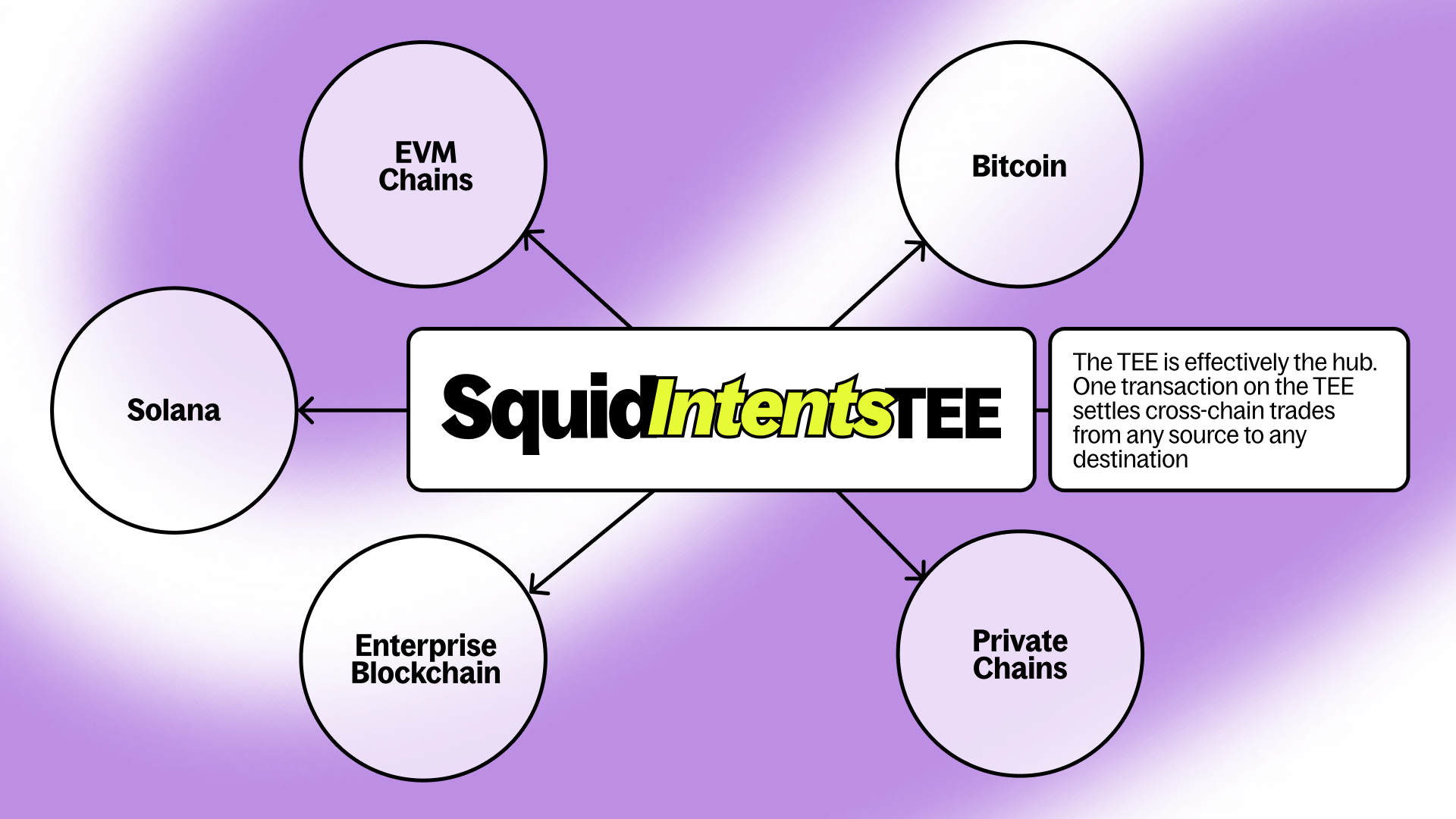
With Squid Intents, execution and logic are handled offchain, meaning we are no longer constrained by smart contracts. Instead, we unlock several benefits at once:
You can go anywhere with any token. That's what Squid, and Squid alone, allows.
We've covered a lot. Let's recap all that Squid has done over the past three years:
Crypto isn’t getting simpler any time soon. More chains are launching, more assets are appearing, more systems are competing to connect them. But from the user’s perspective, none of that complexity should matter. You should be able to say what you want to do and the network should handle the rest.
That’s what Squid has been building toward since day one and is what Squid enables today.
Squid Today, Tomorrow, and each day that follows
Squid is a complex organism, a life-form that has grown and expanded over the years. It’s a layered system of complex ingenuity and design. Some components of the past are still active, while newer releases strengthen our path forward, our journey into the unknown. Squid is a name you know, built from passion and love.
Words come and go, terminology of yesterday feels ancient by noon, and the dopamine chase is like a game. But our purpose isn’t popularity amidst the chaos of noise. We choose something else entirely, without leaving anyone behind.
There is no finish line, only tomorrow and the day after that. Squid will be there for them all.
Please Note
This blog is provided for educational and informational purposes only. This is not investment advice or a recommendation or solicitation for on-chain participation in any mentioned chains, tokens, or assets. Please do your own research before swapping any on-chain assets.