
Peanut + Squid: Cross-Chain Payment Links Made Simple
The physical world operates on a set of unspoken guarantees. When you flip a switch, the light turns on. When you hand over a $10 bill, the cashier hands you a coffee. There is no loading bar, no RPC configuration, and no five-minute wait and pray for the transaction to settle. But in the digital asset world, we’ve spent a decade tolerating a broken social contract. We’ve asked users to become amateur network engineers moving value across a fragmented landscape of L2s. This friction is a UX absurdity that scales poorly. If the goal is to make money a global, fluid language, the infrastructure must become an invisible non-event.
In Buenos Aires and São Paulo we see this becoming a reality for people who are using crypto to hold stable value and to make everyday transactions. For a worker receiving a salary in USDT, that balance is global cash, but to pay for groceries, that value has to hit a Pix or Mercado Pago account instantly.
Peanut was built to bridge this gap, but the technical reality of fragmented L2s makes "instant" a difficult promise to keep. The Peanut team didn't want their users navigating the plumbing of cross-chain swaps, so they integrated the Squid SDK to ensure the routing, gas optimization, and liquidity sourcing happens entirely in the background. When a user sends a Peanut Link for someone to receive digital cash, Squid maps the path .
"For us, payment links—specifically cross-chain payment links—are a big driver of growth... if I send you a $5 Peanut link, I don't need to care which chain you're on." – Konrad Urban, Co-Founder at Peanut
To make a $5 payment link viable, the settlement time has to happen within the window of a real-world interaction. With Squid, Peanut collapsed the standard cross-chain wait from minutes to a few seconds. This optimistic settlement is the baseline for reliability and trust at a merchant counter. When a user sends value, it arrives before the social moment has passed.
For any user, but especially one in a high-inflation environment, price integrity is the baseline for trust. If they send $100, they expect the recipient to claim $100. Traditional AMM-based routing often erodes that balance through slippage and MEV. Peanut utilizes Squid Intents, an intent-based auction layer, to leverage market makers for immediate and efficient settlement, ensuring near-perfect 1:1 parity. This balance of speed and cost, achieved without creating centralized bottlenecks, is what allows Peanut to offer an experience that’s simple and intuitive for anyone.
"Squid does all of the sophisticated routing and finding the best price and best speed, which allows us to have the seamless experience of cross-chain payments." – Konrad Urban, Co-Founder at Peanut
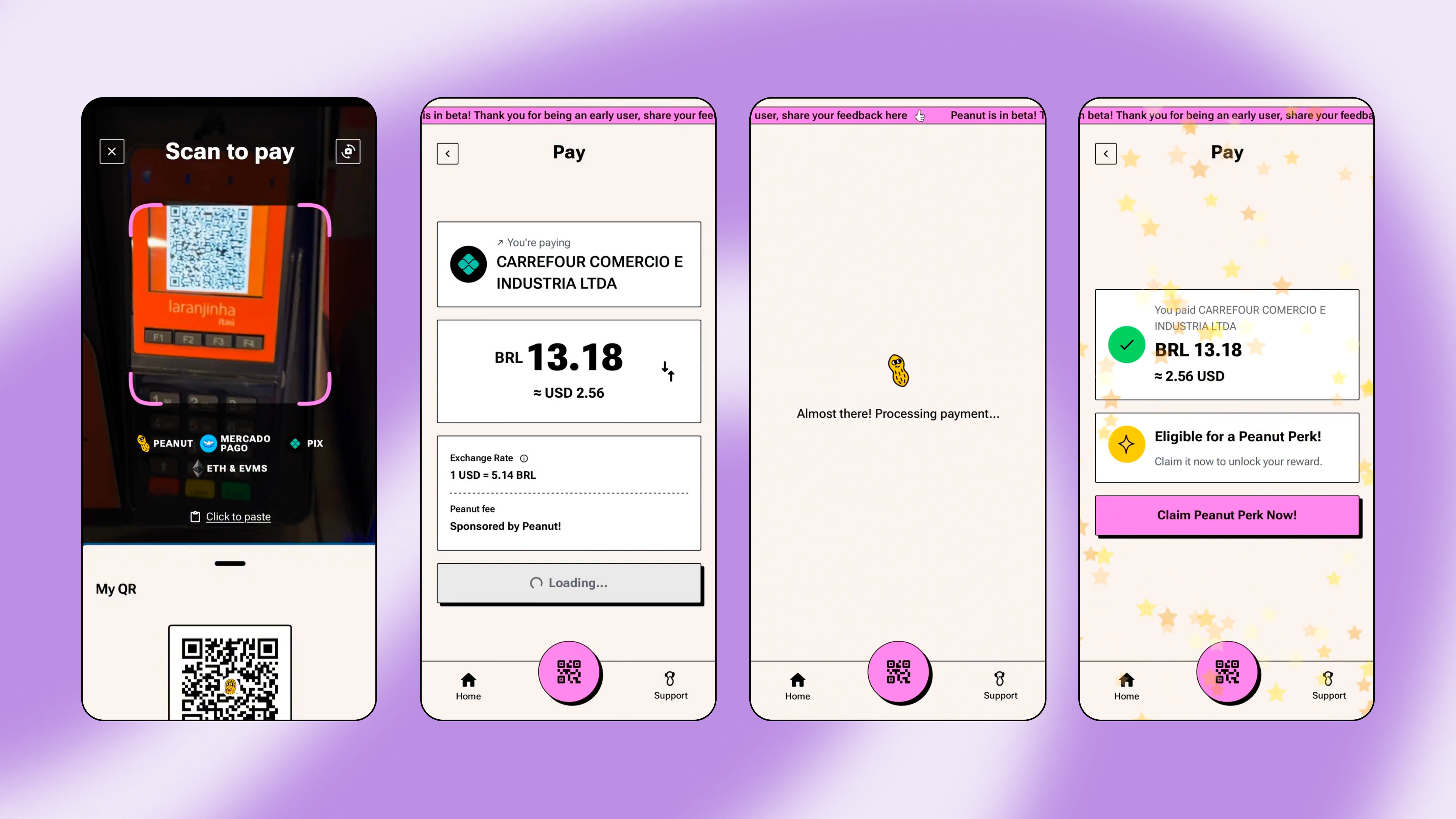
This ease of use has turned the Peanut Link into a viral onboarding engine. Because Squid handles the sophisticated routing and gas optimization in the background, a sender doesn't need to know which chain the recipient is on. A $5 link sent via a messaging app becomes a frictionless gateway into the ecosystem when the recipient claims the funds in their Peanut wallet. Or it’s just as simple to claim those funds and deposit them directly to their bank account, no wallet needed. The recipient claims the funds, and Squid handles the cross-chain logic silently, allowing users to send and receive value on their own terms.
Source: Ari Eiberman on X
The result is a product that finally matches the fluidity of the physical world. By absorbing the complexity of over 100 chains into a single SDK, Squid allows Peanut to focus on the last mile of global payments. As our friends at Peanut put it, in a market like LatAm, users don't want to hear about the plumbing; they just want their money to work. Squid provides the architecture that makes that reality.
"Squid really nicely balances speed and cost with decentralization...we really like the architecture and the fact that it's sufficiently decentralized for our needs. We don't want any centralized bottlenecks unless we absolutely have to have them." – Konrad Urban, Co-Founder at Peanut
Squid’s reliability is anchored in an architecture that prioritizes resilience over convenience. In a global payments context, avoiding centralized bottlenecks is a requirement for a protocol that cannot afford a single point of failure. Maintaining this invisible experience requires constant, high-stakes coordination, and we’re pleased that Peanut finds that "Squid support has been absolutely excellent. There's someone who is always there to respond, and several edge cases have been resolved very, very quickly."
The true measure of this partnership isn’t found in the sophistication of the routing but in the seamless experience of the transaction. Success is the moment a user in Argentina claims a payment without ever hearing the word “bridge.” By moving the messiness of the multi-chain world into the background, Peanut and Squid have turned a technical hurdle into a human guarantee. When money speaks the same language regardless of the chain, crypto stops being a subculture and starts being the global cash it was always meant to be.